270598
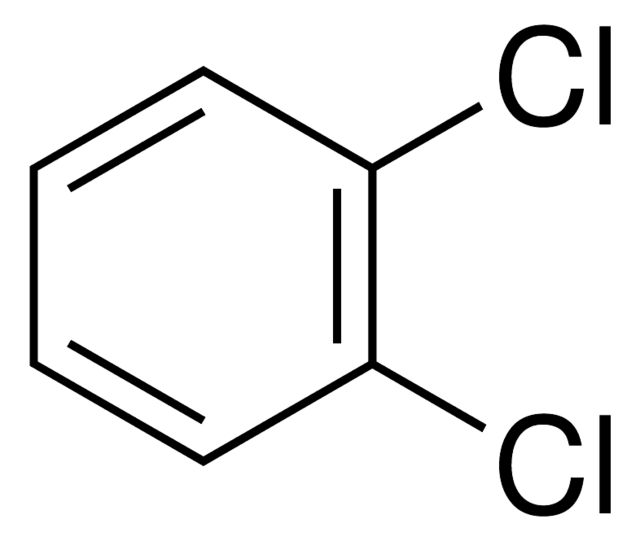
1,2-Dichlorobenzene
suitable for HPLC, 99%
Manufacturer: Sigma Aldrich
CAS Number: 95-50-1
Select a Size
| Pack Size | SKU | Availability | Price |
|---|---|---|---|
| 100 ML | 270598-100-ML | In Stock | ₹ 4,557.33 |
| 1 L | 270598-1-L | In Stock | ₹ 10,207.98 |
270598 - 100 ML
In Stock
Quantity
1
Base Price: ₹ 4,557.33
GST (18%): ₹ 820.319
Total Price: ₹ 5,377.649
vapor density
5.1 (vs air)
Quality Level
100
vapor pressure
1.2 mmHg ( 20 °C)1.6 mmHg ( 35 °C)
Assay
99%
form
liquid
autoignition temp.
1198 °F
purified by
glass distillation
expl. lim.
9.2 %
technique(s)
HPLC: suitable
impurities
<0.020% water
Other Options
Related Products


Description
- Application: Microstructure regulation and enhanced VOC removal performance of carbon aerogels by surface carbon nanotube grown.: This study presents a new method to enhance the removal of volatile organic compounds, including 1,2-Dichlorobenzene, using surface-modified carbon aerogels (Cheng et al., 2024) (Cheng et al., 2024).Role of Electronegativity in Environmentally Persistent Free Radicals (EPFRs) Formation on ZnO.: This research investigates how surface chemistry affects the formation of persistent free radicals, including those from 1,2-Dichlorobenzene on zinc oxide surfaces (Ahmed et al., 2024) (Ahmed et al., 2024).Cu(I) Complexes Catalyzed the Dehydrogenation of N-Heterocycles.: This article discusses the application of copper(I) complexes in catalyzing the dehydrogenation of N-heterocycles, including reactions involving 1,2-Dichlorobenzene derivatives (Shen et al., 2024) (Shen et al., 2024).New Features of Laboratory-Generated EPFRs from 1,2-Dichlorobenzene (DCB) and 2-Monochlorophenol (MCP).: This publication explores the characteristics of laboratory-generated free radicals from 1,2-Dichlorobenzene, shedding light on its environmental impact and degradation processes (Khachatryan et al., 2024) (Khachatryan et al., 2024).Estimate of the C-Cl photoionization cross section and absolute photoionization cross sections of chlorinated organic compounds.: This study provides critical data on the photoionization properties of chlorinated organic compounds, including 1,2-Dichlorobenzene, which is important for understanding its behavior in atmospheric chemistry (Chen et al., 2024) (Chen et al., 2024).
- Recommended products: Discover LiChropur reagents ideal for HPLC or LC-MS analysis
SAFETY INFORMATION
Pictograms
Signal Word
Warning
Hazard Statements
Precautionary Statements
P273 - P280 - P301 + P312 - P302 + P352 - P304 + P340 + P312 - P305 + P351 + P338
Hazard Classifications
Acute Tox. 4 Inhalation - Acute Tox. 4 Oral - Aquatic Acute 1 - Aquatic Chronic 1 - Eye Irrit. 2 - Skin Irrit. 2 - Skin Sens. 1B - STOT SE 3
Target Organs
Respiratory system
WGK
WGK 2
Flash Point(F)
closed cup
Flash Point(C)
closed cup