PHL89766
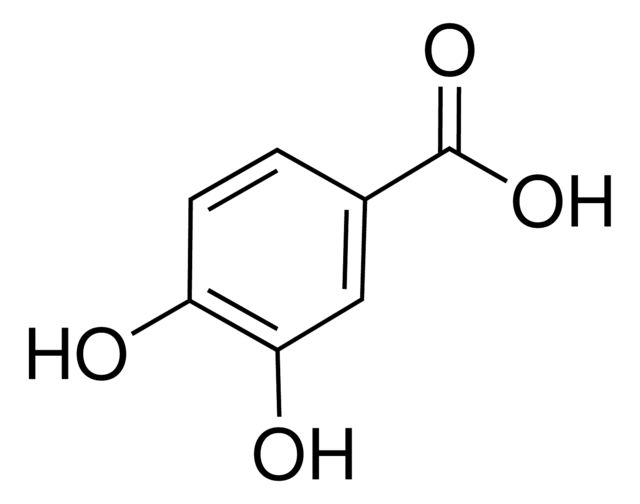
Protocatechuic acid
phyproof® Reference Substance
Manufacturer: Sigma Aldrich
CAS Number: 99-50-3
Synonym(S): 3,4-Dihydroxybenzoic acid, Protocatechuic acid
Select a Size
| Pack Size | SKU | Availability | Price |
|---|---|---|---|
| 100 MG | PHL89766-100-MG | In Stock | ₹ 28,047.58 |
PHL89766 - 100 MG
In Stock
Quantity
1
Base Price: ₹ 28,047.58
GST (18%): ₹ 5,048.564
Total Price: ₹ 33,096.144
grade
primary reference standard
product line
phyproof® Reference Substance
Assay
≥98.0% (HPLC)
form
solid
manufacturer/tradename
PhytoLab
mp
197-200 °C (dec.) (lit.)
SMILES string
OC(=O)c1ccc(O)c(O)c1
InChI
1S/C7H6O4/c8-5-2-1-4(7(10)11)3-6(5)9/h1-3,8-9H,(H,10,11)
InChI key
YQUVCSBJEUQKSH-UHFFFAOYSA-N
Other Options
| Image | Product Name | Manufacturer | Price Range | |
|---|---|---|---|---|
Chem-Impex International, Inc. 3,4-Dihydroxybenzoic acid | 99-50-3 | MFCD00002509 | 25G | -- | ₹ 2,887.65 | ||
Sigma Aldrich Fine Chemicals Biosciences 3,4-Dihydroxybenzoic Acid | 99-50-3 | MFCD00002509 | 25g | -- | ₹ 12,682.56 | ||
eMolecules Ambeed / 34-Dihydroxybenzoic acid / 25g / 552642376 / A202277 / / 99-50-3 / MFCD00002509 / 154.121 / C7H6O4 | -- | ₹ 2,240.82 | ||
3,4-Dihydroxybenzoic acid | -- | ₹ 11,604.40 | ||
Protocatechuic acid | -- | ₹ 20,773.18 | ||
3,4-Dihydroxybenzoic acid | -- | ₹ 6,765.63 - ₹ 16,789.58 | ||
Protocatechuic acid | -- | ₹ 513.36 - ₹ 8,641.56 |
Related Products
Description
- General description: This substance is a primary reference substance with assigned absolute purity (considering chromatographic purity, water, residual solvents, inorganic impurities). The exact value can be found on the certificate. Produced by PhytoLab GmbH & Co. KG
- Application: Bronchom assuages airway hyperresponsiveness in house dust mite-induced mouse model of allergic asthma and moderates goblet cell metaplasia, sub-epithelial fibrosis along with changes in Th2 cytokines and chemokines.: This study highlights the anti-inflammatory properties of Protocatechuic acid, demonstrating its potential as a natural phenolic compound in pharmacological studies and its role in modulating immune responses (Balkrishna et al., 2024).Exploring the Efficacy of Hydroxybenzoic Acid Derivatives in Mitigating Jellyfish Toxin-Induced Skin Damage: Insights into Protective and Reparative Mechanisms.: This research provides insights into the protective and reparative mechanisms of Protocatechuic acid against toxin-induced skin damage, emphasizing its antioxidant properties and applications in biochemistry and dermatology (Geng et al., 2024).Patterns of alteration in boar semen quality from 9 to 37 months old and improvement by protocatechuic acid.: This article investigates the role of Protocatechuic acid in improving semen quality, showcasing its benefits in reproductive biology and potential applications as an antioxidant agent in animal science (Hu et al., 2024).Phytochemical Analysis and Antioxidant Effects of Prunella vulgaris in Experimental Acute Inflammation.: The study details the antioxidant effects of Protocatechuic acid in mitigating acute inflammation, underlining its importance in pharmacological studies and biochemical assays for anti-inflammatory research (Mirza et al., 2024).Phenolic compound profiling and antioxidant potential of different types of Schisandra henryi in vitro cultures.: This research highlights the antioxidant potential and phenolic profiling of Protocatechuic acid, making it a valuable reagent for biochemical assays and studies on natural phenolic compounds (Jafernik et al., 2024).
- Biochem/physiol Actions: Chemopreventive in several animal models of carcinogenesis. Blocks cell proliferation in the post-initiation phase.
- Other Notes: This compound is commonly found in plants of the genus: allium carum cinnamomum curcuma ginkgo humulus melissa pimpinella thymus
- Legal Information: phyproof is a registered trademark of PhytoLab GmbH & Co. KG
SAFETY INFORMATION
Pictograms
Signal Word
Warning
Hazard Statements
Precautionary Statements
P261 - P264 - P271 - P280 - P302 + P352 - P305 + P351 + P338
Hazard Classifications
Eye Irrit. 2 - Skin Irrit. 2 - STOT SE 3
Target Organs
Respiratory system
WGK
WGK 3
Flash Point(F)
Not applicable
Flash Point(C)
Not applicable