PIMA110433
Mouse IgG3 Isotype Control (PPV-07), Invitrogen™
Manufacturer: Thermo Scientific
Select a Size
| Pack Size | SKU | Availability | Price |
|---|---|---|---|
| Each of 1 | PIMA110433-Each-of-1 | In Stock | ₹ 22,031.70 |
PIMA110433 - Each of 1
In Stock
Quantity
1
Base Price: ₹ 22,031.70
GST (18%): ₹ 3,965.706
Total Price: ₹ 25,997.406
Antigen
Mouse IgG3
Clone
PPV-07
Conjugate
Unconjugated
Gene Alias
IgG3; Ighg3; Immunoglobulin G; Immunoglobulin G3; Immunoglobulin heavy constant gamma 3; ImmunoglobulinG; ImmunoglobulinG3
Immunogen
Plum pox virus
Quantity
100 μg
Primary or Secondary
Isotype Control (Primary)
Content And Storage
4° C, do not freeze
Isotype
IgG3
Applications
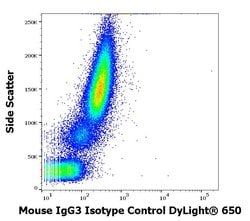
Control, Flow Cytometry, Immunocytochemistry, Immunohistochemistry (Frozen), Immunohistochemistry (Paraffin), Immunoprecipitation
Concentration
1 mg/mL
Formulation
HEPES buffered saline with 15mM sodium azide; pH 7.0
Host Species
Mouse
Purification Method
Protein A
Regulatory Status
RUO
Target Species
Not Applicable
Form
Liquid
Related Products



Description
- This antibody will not cross-react with human, porcine, mouse or rat
- Mouse IgG3 is a subtype of immunoglobulin G antibody that is produced by B cells in response to an antigen
- It is the least abundant IgG subtype in the serum and plays a crucial role in the adaptive immune response
- Mouse IgG3 is composed of two heavy chains and two light chains, and it is involved in opsonization, complement activation, and antibody-dependent cell-mediated cytotoxicity
- It is also involved in the regulation of immune responses, including the activation of T cells and the inhibition of B cell activation
- Mouse IgG3 is less commonly used in research and diagnostic applications compared to other IgG subtypes, but it is still used in some applications such as ELISA and immunohistochemistry.