A21311
GFP Polyclonal Antibody, Alexa Fluor™ 488, Invitrogen™
Manufacturer: Invitrogen
Select a Size
| Pack Size | SKU | Availability | Price |
|---|---|---|---|
| Each of 1 | A21311-Each-of-1 | In Stock | ₹ 43,293.36 |
A21311 - Each of 1
In Stock
Quantity
1
Base Price: ₹ 43,293.36
GST (18%): ₹ 7,792.805
Total Price: ₹ 51,086.165
Antigen
GFP
Classification
Polyclonal
Conjugate
Alexa Fluor 488
Gene Alias
GFP; GFP tag; GFP2; green fluorescence; green fluorescent; Turbo eGFP
Immunogen
The GFP was isolated directly from the jellyfish Aequorea victoria.
Quantity
100 μL
Primary or Secondary
Primary
Content And Storage
4° C, store in dark
Form
Liquid
Target Molecule
Tag
Applications
Immunocytochemistry, Immunohistochemistry, Western Blot
Concentration
2 mg/mL
Formulation
PBS with 5mM sodium azide; pH 7.5
Host Species
Rabbit
Purification Method
IgG fraction
Regulatory Status
RUO
Target Species
Tag
Product Type
Antibody
Isotype
IgG
Related Products


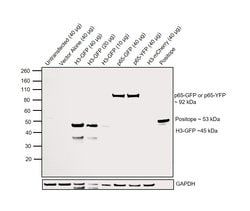

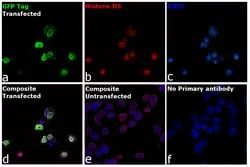
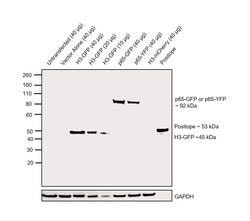

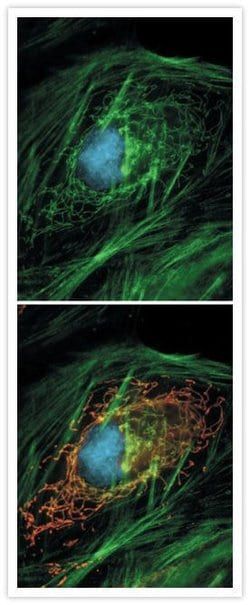
Description
- To achieve appropriate staining results on formalin-fixed, paraffin embedded tissue sections, protease Type XIV (Actinase E) pretreatment is required
- The recommended dilution and incubation for protease is 1-2 mg/mL at 37°C for 10 minutes
- Other enzyme and Heat Induced Epitope Retrieval pre-treatment methods may not be suitable for this particular antibody
- Frozen sections have been successfully stained after fixation with acetone at 4°C
- The jellyfish Aequorea victoria contains green fluorescent protein (GFP Tag) that emits light in the bioluminescence reaction of the animal
- GFP has been used widely as a reporter protein for gene expression in eukaryotic and prokaryotic organisms, and as a protein tag in cell culture and in multicellular organisms
- As a fusion tag, GFP can be used to localize proteins, to study their movement or to research the dynamics of the subcellular compartments where these proteins are targeted
- GFP technology has revealed considerable new insights in the physiological activities of living cells
- GFP is a 27 kDa monomeric protein, which autocatalytically forms a fluorescent pigment
- The wild type protein absorbs blue light (maximally at 395nm) and emits green light (peak emission 508nm) in the absence of additional proteins, substrates, or co-factors
- GFP fluorescence is stable, species independent and is suitable for a variety of applications
- GFP has been used extensively as a fluorescent tag to monitor gene expressin and protein localization
- Moreover, other applications for GFP include its use in assessing protein protein interactions in the yeast two hybrid system, and in measuring distances between proteins in fluorescence energy transfer (FRET) experiments
- Order Info Shipping Condition: Wet Ice