7238533
Invitrogen™ Vybrant™ FLICA Caspase Apoptosis Assay Kits for flow cytometry
Detect apoptosis via flow cytometry with Vybrant FLICA Caspase Assays that detect poly and caspase-3/7/8 activities.
Manufacturer: Fischer Scientific
The price for this product is unavailable. Please request a quote
Format
Tube
Flow Cytometer Laser Lines
UV, 488
Product Line
Vybrant
For Use With (Equipment)
Flow Cytometer
Storage Requirements
Store in refrigerator (2–8°C) and protect from light.
Product Type
Caspase Assay Kit
Shipping Condition
Room Temperature
Detection Method
Fluorescence
Label Type
Other Label(s) or Dye(s)
Related Products
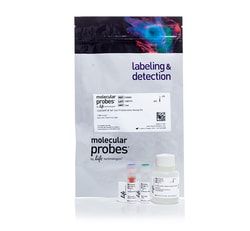

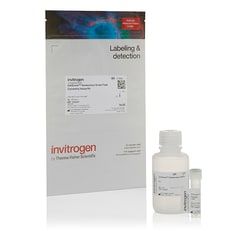
Description
- Quickly detect caspase-mediated apoptosis by flow cytometry with Vybrant FAM caspase assay kits for poly-caspases and caspases 3 and 7
- The Vybrant FAM caspase assay kits use fluorescent inhibitor of caspases (FLICA) methodology to detect and report caspase activity
- Specifically, these caspase assay kits contain engineered FLICA substrates FAM-VAD-FMK (for poly-caspases), FAM-DEVD-FMK (for caspase-3/7), and FAM-LETD-FMK (for caspase-8)
- They also include Hoechst 33342 and propidium iodide stains, enabling simultaneous evaluation of membrane permeability and cell cycle by flow cytometry
- The Vybrant FAM caspase assay kits for flow cytometry employ a novel approach to detecting active caspases: the kits take advantage of FLICA methodology, which is an affinity label
- This affinity label associates a fluoromethyl ketone (FMK) moiety, which can react covalently with a cysteine, with a caspase-specific amino acid sequence
- Different amino acid recognition sequences are used to detect different caspases: valine-alanine-aspartic acid (VAD) for poly caspases (including caspase-1, -3, -4, -5, -6, -7, -8, and -9), aspartic acid-glutamic acid-valine-aspartic acid (DEVD) for caspase-3/7, and leucine-glutamic acid-threonine-aspartic acid (LETD) for caspase-8
- A carboxyfluorescein (FAM) group is attached as a reporter
- The FLICA reagent is thought to interact with the enzymatic reactive center of an activated caspase via the recognition sequence, and then to attach covalently through the FMK moiety
- The FLICA inhibitor is cell permeant and noncytotoxic
- Unbound FLICA molecules diffuse out of the cell and are washed away; the remaining fluorescent signal is a direct measure of the amount of active caspase present at the time the inhibitor was added
- The approximate excitation and emission peaks of the FLICA, propidium iodide, and Hoechst 33342 reagents are 488 nm/⁄530 nm, 535⁄ nm/6617 nm, and 350 nm/⁄461 nm, respectively
- The detection reagents included within the individual Vybrant FAM Poly Caspases Assay, Caspase-3 and -7 Assay, and Caspase-8 Assay apoptosis kits are 488⁄⁄530 FAM-VAD-FMK reagent, 488/⁄530 FAM-DEVD-FMK, and 488/⁄530 FAM-LETD-FMK, respectively.