PI62247
Thermo Scientific™ DAPI (4',6-diamidino-2-phenylindole, dihydrochloride)
Manufacturer: Thermo Scientific™
The price for this product is unavailable. Please request a quote
Color
Blue
Excitation Wavelength Range
360 nm
For Use With (Application)
Cell imaging
Quantity
10 mg
Description
DAPI (4',6-diamidino-2-phenylindole, dihydrochloride)
Product Line
Pierce™
Label Type
Fluorescent Dye
SubCellular Localization
Nucleus
Content And Storage
Store at room temperature and protect from light.
Dye Type
Cell-Impermeant
For Use With (Equipment)
Fluorescence Microscope, High Content Instrument
Detection Method
Fluorescence
Emission
460 nm
Shipping Condition
Room Temperature
Product Type
DAPI
Related Products
Description
- Thermo Scientific™ Pierce DAPI Nuclear Counterstains are high-purity forms of diamidino-2-phenylindole dye for fixed-cell, fluorescent staining of DNA content and nuclei for cellular imaging techniques
- Thermo Scientific Pierce DAPI Nuclear Counterstains are high-purity forms of diamidino-2-phenylindole dye for fixed-cell, fluorescent staining of DNA content and nuclei for cellular imaging techniques
- DAPI (diamidino-2-phenylindole) is a blue fluorescent probe that fluoresces brightly upon selectively binding to the minor groove of double stranded DNA, where its fluorescence is approximately 20-fold greater than in the nonbound state
- Its selectivity for DNA and high cell permeability allows efficient staining of nuclei with little background from the cytoplasm
- DAPI is a classic nuclear counterstain for immunofluorescence microscopy, as well as an important component of high-content screening methods requiring cell-based quantitation of DNA content
- Features of DAPI Nuclear Counterstain: DAPI dye —diamidino-2-phenylindole is a blue fluorescent stain specific for DNA Convenient —choose powder or easy-to-use DAPI dye solution (1 mg/mL) Cellular imaging —cell-permeable dye is effective for fixed-cell staining and quantitation of DNA content Counterstain —ideal for use alongside detection of specific targets with fluorescent antibodies for fluorescence microscopy or high-content screening (HCS) Properties of DAPI Fluorescent Dye: Alternative names: DAPI Stain, DAPI Dye, DNA Content Counterstain Chemical name(s): 4,6'-diamidino-2-phenylindole, dihydrochloride; 4',6-diamidine-2-phenyl indole; 2-(4-Amidinophenyl)-6-indolecarbamidine dihydrochloride Molecular formula: C 16 H 15 N 5 · 2HCl Molecular weight: 350.25 Excitation wavelength: 341 ± 3 nm (near 360 nm when bound to dsDNA) Emission wavelength: 452 ± 3 nm (456 to 460 nm when bound to dsDNA) Extinction coefficient: >30,600/M cm at 347 nm in methanol CAS #: 28718-90-3 Purity: >95% (most lots >98%) by HPLC at 240 nm Solubility: >1 mg/mL in water; compound is soluble in DMF, water and various non-phosphate aqueous buffers Reactive groups: None; binds to minor groove of double-stranded DNA As a counterstain in fluorescence imaging methods, DAPI is compatible with antibodies and other probes labeled with fluorescein (Cat
- No
- 53027) and rhodamine (Cat
- No
- 46112) dyes, as well as with Thermo Scientific DyLight Fluors
- DAPI has greater photostability than Hoechst dyes, although Hoechst 33342 can be use for live cell imaging while use of DAPI is confined to fixed cells
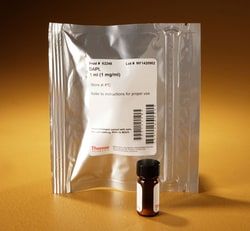
- DAPI is offered in powdered solid and aqueous solution forms
- Applications for DAPI Stain: Assaying DNA in solution (ref.4) Diagnosing mycoplasmal infection of cell cultures (ref.5) Measuring nuclear content and sorting chromosomes in flow cytometry (ref.6) Assessing apoptosis (ref.7) Detecting nuclei and organellar DNA in immunofluorescent and in situ hybridization procedures (ref.2,8) Replacing ethidium bromide for staining DNA in agarose gels (ref.5,9) Counterstaining nuclei in histochemical methods when red-fluorescent antibodies have been used to detect specific targets (ref.8) Reports also indicate that DAPI will bind to polyphosphates and other polyanions (ref.10), dextran sulfate (ref.11) and SDS (ref.12)
- Related Products DAPI Solution, 1 mg/mL (Cat
- No
- 62248)