95212
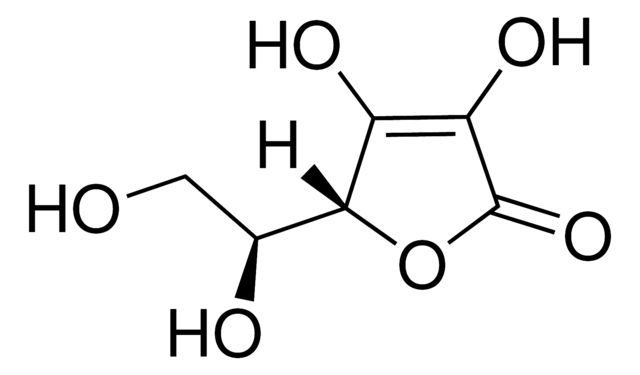
L-Ascorbic acid
tested according to Ph. Eur.
Manufacturer: Sigma Aldrich
CAS Number: 50-81-7
Synonym(S): Acidum ascorbicum, L-Threoascorbic acid, Antiscorbutic factor, Vitamin C
Select a Size
| Pack Size | SKU | Availability | Price |
|---|---|---|---|
| 250 G | 95212-250-G | In Stock | ₹ 7,794.00 |
| 1 KG | 95212-1-KG | In Stock | ₹ 25,114.00 |
95212 - 250 G
In Stock
Quantity
1
Base Price: ₹ 7,794.00
GST (18%): ₹ 1,402.92
Total Price: ₹ 9,196.92
biological source
synthetic
Quality Level
200
Agency
USP/NFtested according to Ph. Eur.
Assay
99.0-100.5%
form
solid
color
white to off-white
pH
1.0-2.5 (25 °C, 176 g/L in water)
mp
190-194 °C (dec.)
solubility
water: soluble 176 g/L at 20 °C
SMILES string
OC([C@]([C@@H](O)CO)([H])O1)=C(O)C1=O
Other Options
| Image | Product Name | Manufacturer | Price Range | |
|---|---|---|---|---|
Tocris Bioscience™ L-Ascorbic acid | -- | ₹ 40,726.56 | ||
Ascorbic Acid, Pharmaceutical Secondary Standard, Certified Reference Material, MilliporeSigma™ Supelco™ | -- | ₹ 61,859.88 | ||
Ascorbic Acid Pharmaceutical Secondary Standard, MilliporeSigma™ Supelco™ | -- | ₹ 13,518.48 | ||
L-Ascorbic acid, MilliporeSigma™ Supelco™ | -- | ₹ 2,643.80 | ||
TraceCERT™ L-Ascorbic Acid, 99.1%, MilliporeSigma™ Supelco™ | -- | ₹ 15,058.56 | ||
Selleck Chemical LLC Vitamin C 50mg 50-81-7 Ascorbic acid | -- | ₹ 15,092.78 | ||
Sigma Aldrich Fine Chemicals Biosciences Ascorbic acid United States Pharmacopeia (USP) Reference Standard | 50-81-7 | MFCD00064328 | 1G | -- | ₹ 46,921.10 | ||
Medchemexpress LLC HY-B0166 1g , L-Ascorbic acid L-Ascorbate;Vitamin C CAS:50-81-7 Purity:98% | -- | ₹ 4,491.90 | ||
Sigma Aldrich Fine Chemicals Biosciences L-Ascorbic acid, 50-81-7, MFCD00064328, 500 G | -- | ₹ 18,446.74 | ||
Sigma Aldrich Fine Chemicals Biosciences L-Ascorbic acid | 50-81-7 | MFCD00064328 | 500g | -- | ₹ 11,424.83 |
...
Related Products
Description
- General description: L-Ascorbic acid is the most biologically active form of ascorbic acid. It is hydrophilic and an unstable compound.[1] L-Ascorbic acid contains a six-carbon lactone produced by plants and some animal species but not by humans and other primates. Ascorbic acid, also referred to as Vitamin C, is a water-soluble vitamin.[2] Ascorbic acid carries a neutral charge, which gets converted to ascorbate by protonation.[3] Vitamin C is a part of citrus fruits, such as broccoli, strawberries, turnip.[2]
- Application: Targeted screening of multiple anti-inflammatory components from Chrysanthemi indici Flos by ligand fishing with affinity UF-LC/MS: This study investigates the application of L-Ascorbic acid in enhancing the screening of anti-inflammatory compounds, utilizing its properties to stabilize reactive samples in cell cultures (Huang et al., 2024).Phenolic Content, Antioxidant Potential, and Antimicrobial Activity of Uvaria chamae (Annonaceae), a Food Plant from Burkina Faso: Demonstrates the use of L-Ascorbic acid in the evaluation of antioxidant properties of plant extracts, which is crucial in the pharmaceutical research of natural products (Kabore et al., 2024).
- Biochem/physiol Actions: L-Ascorbic acid functions according to its oxido-reduction property. It is a co-factor for hydroxylation. The biochemical actions of L-ascorbic acid is dependent on the activity of monoxygenase. It is involved in carnitine, collagen synthesis and production of neurotransmitters.[2] Vitamin C exhibits anti-oxidant properties. Vitamin C plays a role in providing protection against photoaging and anti-aging effect.[1] Deficiency of vitamin C leads to scurvy, bleeding gums, poor wound healing, anemia and muscle degeneration.[2]
SAFETY INFORMATION
WGK
WGK 1
Flash Point(F)
Not applicable
Flash Point(C)
Not applicable
Personal Protective Equipment
dust mask type N95 (US), Eyeshields, Gloves