A5960
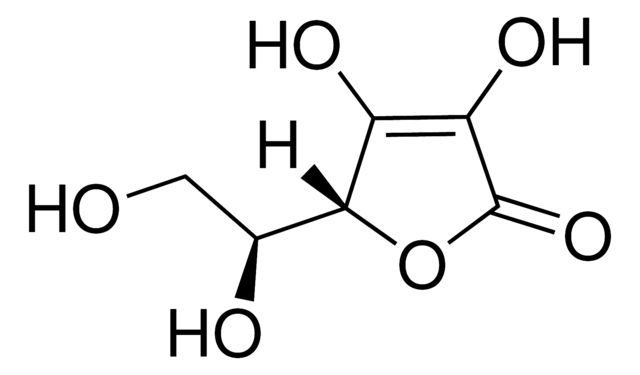
L-Ascorbic acid
BioXtra, ≥99.0%, crystalline
Manufacturer: Sigma Aldrich
CAS Number: 50-81-7
Synonym(S): L-Threoascorbic acid, Antiscorbutic factor, Vitamin C
Select a Size
| Pack Size | SKU | Availability | Price |
|---|---|---|---|
| 10 MG | A5960-10-MG | In Stock | ₹ 2,470.00 |
| 25 G | A5960-25-G | In Stock | ₹ 5,280.00 |
| 100 G | A5960-100-G | In Stock | ₹ 14,500.00 |
| 500 G | A5960-500-G | In Stock | ₹ 51,299.68 |
A5960 - 10 MG
In Stock
Quantity
1
Base Price: ₹ 2,470.00
GST (18%): ₹ 444.60
Total Price: ₹ 2,914.60
product line
BioXtra
Quality Level
200
Assay
≥99.0%
form
crystalline
technique(s)
cell culture | mammalian: suitable
impurities
≤0.0005% Phosphorus (P)≤0.1% Insoluble matter
ign. residue
≤0.1%
color
white to off-white
pH
1.0-2.5 (25 °C, 176 g/L in water)
mp
190-194 °C (dec.)
Other Options
| Image | Product Name | Manufacturer | Price Range | |
|---|---|---|---|---|
Tocris Bioscience™ L-Ascorbic acid | -- | ₹ 40,726.56 | ||
Ascorbic Acid, Pharmaceutical Secondary Standard, Certified Reference Material, MilliporeSigma™ Supelco™ | -- | ₹ 61,859.88 | ||
Ascorbic Acid Pharmaceutical Secondary Standard, MilliporeSigma™ Supelco™ | -- | ₹ 13,518.48 | ||
L-Ascorbic acid, MilliporeSigma™ Supelco™ | -- | ₹ 2,643.80 | ||
TraceCERT™ L-Ascorbic Acid, 99.1%, MilliporeSigma™ Supelco™ | -- | ₹ 15,058.56 | ||
Selleck Chemical LLC Vitamin C 50mg 50-81-7 Ascorbic acid | -- | ₹ 15,092.78 | ||
Sigma Aldrich Fine Chemicals Biosciences Ascorbic acid United States Pharmacopeia (USP) Reference Standard | 50-81-7 | MFCD00064328 | 1G | -- | ₹ 46,921.10 | ||
Medchemexpress LLC HY-B0166 1g , L-Ascorbic acid L-Ascorbate;Vitamin C CAS:50-81-7 Purity:98% | -- | ₹ 4,491.90 | ||
Sigma Aldrich Fine Chemicals Biosciences L-Ascorbic acid, 50-81-7, MFCD00064328, 500 G | -- | ₹ 18,446.74 | ||
Sigma Aldrich Fine Chemicals Biosciences L-Ascorbic acid | 50-81-7 | MFCD00064328 | 500g | -- | ₹ 11,424.83 |
...
Related Products
Description
- General description: Ascorbic acid is also referred to as Vitamin C.[1] It contains a six-carbon lactone produced by plants and some animal species but not by humans and other primates. Vitamin C is a water-soluble vitamin.[2] Vitamin C is a part of citrus fruits, such as Indian gooseberry, broccoli, strawberries, brussels sprouts.[2] L-ascorbic acid is the biologically active form of ascorbic acid. It is unstable and hydrophilic.[1] Ascorbic acid carries a neutral charge, which gets converted to ascorbate by protonation.[3]
- Application: L-Ascorbic acid has been used to induce osteoblast differentiation from primary bone marrow cultures.[4]It has been used for the differentiation of hCMPCs (human cardiomyocyte progenitor cells) into cardiomyocytes.[5] It has been used to measure the mitochondrial electron transport chain (complex IV) activity.[6]
- Biochem/physiol Actions: L-Ascorbic acid plays a role in production of neurotransmitters, carnitine and collagen synthesis.[2] Ascorbic acid functions as an enzymatic cofactor for multiple enzymes, serving as an electron donor for monooxygenases and dioxygenases. Ascorbic acid also functions as a powerful antioxidant, particularly in regards to reactive oxygen species.[7] Vitamin C exhibits anti-oxidant properties. Vitamin C is implicated in conferring protection against photoaging and anti-aging.[1] Deficiency of vitamin C is associated with scurvy, bleeding gums, poor wound healing, anemia and muscle degeneration.[2]
- Caution: May darken in storage.
- Other Notes: 2024 CiteAb Award Winner for Supplier Succeeding in Parkinson′s Research
SAFETY INFORMATION
WGK
WGK 1
Flash Point(F)
Not applicable
Flash Point(C)
Not applicable
Personal Protective Equipment
dust mask type N95 (US), Eyeshields, Gloves