S90741
Innovating Science™ AP Chemistry Kits:Electrochemical Cells
Manufacturer: Innovating Science™
Select a Size
| Pack Size | SKU | Availability | Price |
|---|---|---|---|
| Each of 1 | S90741-Each-of-1 | In Stock | ₹ 4,705.80 |
S90741 - Each of 1
In Stock
Quantity
1
Base Price: ₹ 4,705.80
GST (18%): ₹ 847.044
Total Price: ₹ 5,552.844
Certifications/Compliance
49 CFR 173.4
Color
White
Age
13 to 20
Includes
2 x 500mL Cupric Sulfate, 0.5M solution, 1 x 25mL Bromothymol Blue, 0.04% solution, 8 x 500mL Sodium Sulfate, 1M solution, Copper Metal strips, Magnesium Metal strips 5 in., dialysis tubing strips 6 in., teacher's guide and student study guide copymasters
Dimensions (L x W x H)
10.25 x 10.25 x 8.5 in.
Product Type
Electrochemical Cells Chemistry Kit
Grade
7 to 14
For Use With (Application)
To study electrolysis of water produces hydrogen and oxygen
Quantity
1
Class Size
15 Lab Groups
Related Products







Description
- The tendency of oxidation-reduction reactions is to proceed to an equilibrium state
- In electrochemical cells, these reactions provide another way for us to express the driving force in chemical reactions
- When reagents that accept or donate electrons are arranged so that the electrons can enter or leave the reaction through a metallic conductor, an electrochemical cell is established
- A half-cell contains a metal in contact with a solution of its salt
- Each metal will develop a different electrical potential based on its electron configuration
- The standard reduction potential listed in various references is the voltage that a half-cell develops when combined with a hydrogen half-cell
- First, construct a simple chemical battery and determine from the standard reduction potentials what the output of the battery will be (if a voltmeter is available the actual and theoretical voltages can be compared)
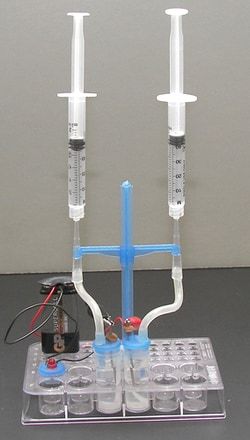
- Second, construct an electrolysis cell and demonstrate how hydrogen and oxygen can be produced from the electrolysis of water
- Electrolysis cell is the reverse of a battery where a voltage higher than the reversible electromotive force of the cell is applied to the electrodes In a cell containing water and an electrolyte, the oxidation reaction occurring at the anode produces oxygen gas while the reduction occurring at the cathode produces hydrogen gas By the addition of a pH indicator, the oxidation-reduction reactions can be monitored visually Gases produced are collected in inverted test tubes and the volumes of hydrogen and oxygen are compared