241911
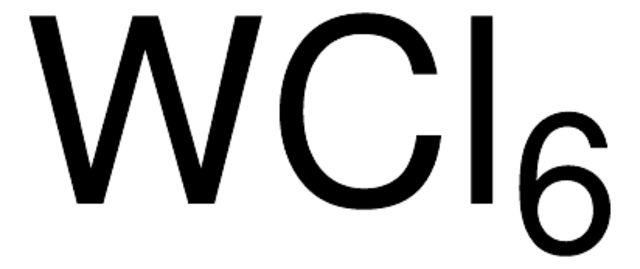
Tungsten(VI) chloride
≥99.9% trace metals basis
Manufacturer: Sigma Aldrich
CAS Number: 13283-01-7
Synonym(S): Tungsten hexachloride
Select a Size
| Pack Size | SKU | Availability | Price |
|---|---|---|---|
| 10 G | 241911-10-G | In Stock | ₹ 7,014.60 |
| 100 G | 241911-100-G | In Stock | ₹ 28,686.25 |
241911 - 10 G
In Stock
Quantity
1
Base Price: ₹ 7,014.60
GST (18%): ₹ 1,262.628
Total Price: ₹ 8,277.228
vapor pressure
43 mmHg ( 215 °C)
Quality Level
100
Assay
≥99.9% trace metals basis
form
powder
reaction suitability
reagent type: catalystcore: tungsten
impurities
≤1000.0 ppm Trace Metal Analysis
bp
347 °C (lit.)
mp
275 °C (lit.)
density
3.52 g/mL at 25 °C (lit.)
SMILES string
Cl[W](Cl)(Cl)(Cl)(Cl)Cl
Other Options
| Image | Product Name | Manufacturer | Price Range | |
|---|---|---|---|---|
Strem, An Ascensus Company CAS# 13283-01-7. 100g. Tungsten(VI) chloride (99.9%-W). MFCD00011463 | -- | ₹ 24,025.25 | ||
Strem, An Ascensus Company CAS# 13283-01-7. 25g. Tungsten(VI) chloride (99.9%-W). MFCD00011463 | -- | ₹ 8,521.78 | ||
Sigma Aldrich Fine Chemicals Biosciences Tungsten(VI) chloride >=99.9% trace metals basis | 13283-01-7 | MFCD00011463 | 100G | -- | ₹ 37,522.34 | ||
Sigma Aldrich Fine Chemicals Biosciences Tungsten(VI) chloride powder, >=99.99% trace metals basis (purity excludes molybdenum) | 13283-01-7 | MFCD00011463 | 25G | -- | ₹ 1,10,047.27 | ||
Tungsten(VI) chloride | -- | ₹ 12,849.28 - ₹ 93,354.80 | ||
Tungsten(VI) chloride | -- | ₹ 7,014.60 - ₹ 28,686.25 | ||
13283-01-7 | Tungsten chloride (WCl6), (OC-6-11)- | -- | ₹ 1,540.08 - ₹ 15,058.56 |
Related Products
Description
- General description: Tungsten(VI) chloride is a highly reactive crystalline solid commonly used in the field of catalysis, perovskite solar cells, and light-emitting devices. It is a diamagnetic solid. However, it can be highly corrosive and have strong oxidizing effects.
- Application: Tungsten(VI) chloride can be used:As a starting material to synthesize tungsten nanoparticles[1] and Mo-doped urchin-like W18O49 Nanostructure using the hydrothermal method. The Mo-W18O49 electrocatalyst exhibited excellent electrocatalytic activity toward Hydrogen Evolution Reaction (HER).[2] By doping Mo species into defect-rich W18O49 ultrathin nanowires, it has also been demonstrated to be an excellent candidate for photocatalytic N2 fixation to ammonia.[3]To synthesize crystalline mesoporous WO3 with 11 nm pore size utilizing a high-molecular-weight amphiphilic block copolymer as the structure-directing agent. The materials performed admirably in terms of H2S gas sensing.[4]To fabricate Tungsten disulfide and WS2/reduced graphene oxide (WS2/rGO) nanosheets by hydrothermal synthesis. The WS2/rGO nanosheets showed exceptional electrocatalytic activity for the hydrogen evolution reaction. To produce the WS2-nanoflowers@rGO and nitrogen-doped carbon spheres@WS2 composite as an anode material for enhanced electrode performance in lithium-ion batteries.[5]As a dopant to fabricate TiO2 compact layers for perovskite solar cells with enhanced performance.[6]As a catalyst to prepare self-healing epoxy composites with microcapsules.[7]As a catalyst for transamidation of tertiary alkyl amides.[8]
SAFETY INFORMATION
Pictograms
Signal Word
Danger
Hazard Statements
Precautionary Statements
P260 - P271 - P273 - P280 - P303 + P361 + P353 - P305 + P351 + P338
Hazard Classifications
Aquatic Chronic 3 - Eye Dam. 1 - Skin Corr. 1B - STOT SE 3
Target Organs
Respiratory system
WGK
WGK 3
Flash Point(F)
Not applicable
Flash Point(C)
Not applicable
Personal Protective Equipment
dust mask type N95 (US), Eyeshields, Gloves