229601
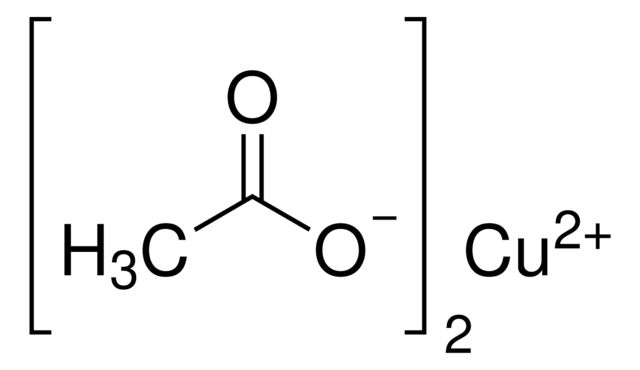
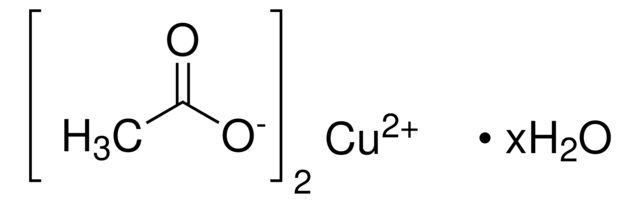
Copper(II) acetate monohydrate
99.99% trace metals basis
Manufacturer: Sigma Aldrich
CAS Number: 6046-93-1
Synonym(S): Cupric acetate monohydrate
Select a Size
| Pack Size | SKU | Availability | Price |
|---|---|---|---|
| 10 G | 229601-10-G | In Stock | ₹ 15,414.80 |
| 50 G | 229601-50-G | In Stock | ₹ 70,156.83 |
229601 - 10 G
In Stock
Quantity
1
Base Price: ₹ 15,414.80
GST (18%): ₹ 2,774.664
Total Price: ₹ 18,189.464
vapor density
6.8 (vs air)
Quality Level
200
Assay
99.99% trace metals basis
form
powder or crystals
reaction suitability
core: copper
greener alternative product characteristics
CatalysisLearn more about the Principles of Green Chemistry.
sustainability
Greener Alternative Product
greener alternative category
Aligned
SMILES string
O.CC(=O)O[Cu]OC(C)=O
InChI
1S/2C2H4O2.Cu.H2O/c2*1-2(3)4;;/h2*1H3,(H,3,4);;1H2/q;;+2;/p-2
Other Options
Related Products
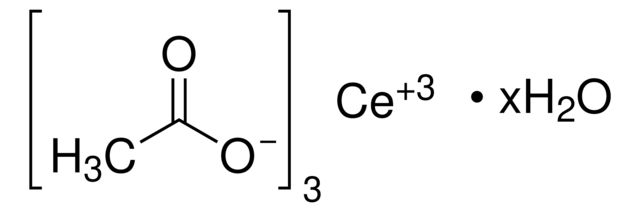
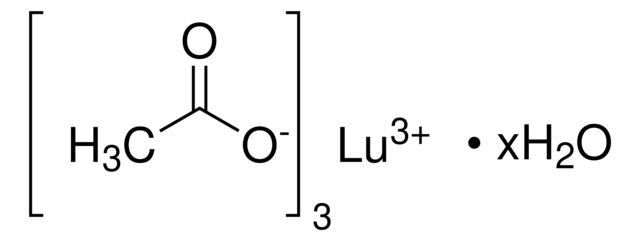
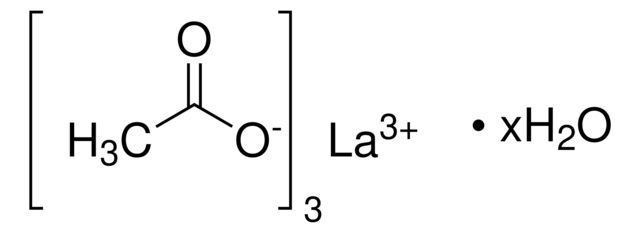
Description
- General description: Copper (II) acetate monohydrate is soluble in water and slightly soluble in methanol, diethylether and acetone. It can be synthesized by reacting acetic acid with copper (II) carbonate or copper(II) hydroxide or copper (II) oxide. Large scale commercial production is undertaken by placing copper metal in the presence of air and refluxing acetic acid. As a transition metal acetate, it can be used to form oxide nanoparticles by sonochemical methods.
- Application: Used in the synthesis of copper oxide nanoparticles,[1] Cu2ZnSnS4 films, which find applications in solar cells.[2] It may be used in Zinc Oxide varistors, as a catalyst in the polymerization of organic materials and as a mordant in the dying of textiles. Industrially, it may be used as a ceramic pigment and as a fungicide.
SAFETY INFORMATION
Pictograms
Signal Word
Danger
Hazard Statements
Precautionary Statements
P260 - P273 - P280 - P301 + P312 - P303 + P361 + P353 - P305 + P351 + P338
Hazard Classifications
Acute Tox. 4 Oral - Aquatic Acute 1 - Aquatic Chronic 2 - Eye Dam. 1 - Skin Corr. 1B
WGK
WGK 3
Flash Point(F)
does not flash
Flash Point(C)
does not flash
Personal Protective Equipment
dust mask type N95 (US), Eyeshields, Gloves