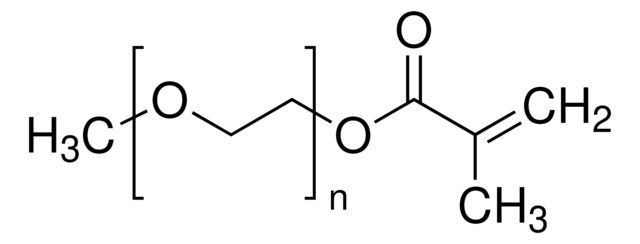
Poly(ethylene glycol) methyl ether methacrylate
average Mn 950, methacrylate, methoxy, 300 ppm BHT as inhibitor, 100 ppm MEHQ as inhibitor
Manufacturer: Sigma Aldrich
CAS Number: 26915-72-0
Synonym(S): Polyethylene glycol, Methoxy PEG methacrylate, Methoxy poly(ethylene glycol) monomethacrylate, Poly(ethylene glycol) monomethyl ether monomethacrylate
Select a Size
| Pack Size | SKU | Availability | Price |
|---|---|---|---|
| 100 ML | 447951-100-ML | In Stock | ₹ 4,936.20 |
| 500 ML | 447951-500-ML | In Stock | ₹ 13,368.88 |
447951 - 100 ML
In Stock
Quantity
1
Base Price: ₹ 4,936.20
GST (18%): ₹ 888.516
Total Price: ₹ 5,824.716
product name
Poly(ethylene glycol) methyl ether methacrylate, average Mn 950, contains 100 ppm MEHQ as inhibitor, 300 ppm BHT as inhibitor
form
solid
Quality Level
200
mol wt
average Mn 950
contains
100 ppm MEHQ as inhibitor300 ppm BHT as inhibitor
reaction suitability
reagent type: chemical modification reagentreaction type: Polymerization Reactions
mp
33-38 °C
density
1.1 g/mL at 25 °C
Ω-end
methacrylate
α-end
methoxy
Other Options
Related Products

Description
- Application: Redox-Responsive "Catch and Release" Cryogels: A Versatile Platform for Capture and Release of Proteins and Cells.: This study introduces innovative cryogels incorporating Poly(ethylene glycol) methyl ether methacrylate, emphasizing their applications in protein and cell capture and release systems. These cryogels exhibit redox-responsive behavior, making them suitable for advanced biomedical applications, including targeted drug delivery and tissue engineering (Calik et al., 2024).Study of mechanical property and biocompatibility of graphene oxide/MEO(2)MA hydrogel scaffold for wound healing application.: The research explores the mechanical properties and biocompatibility of a hydrogel scaffold combining graphene oxide and Poly(ethylene glycol) methyl ether methacrylate (PEGMEM). This scaffold shows potential for enhanced wound healing applications due to its robust mechanical strength and excellent biocompatibility (Luong et al., 2024).Constructing the Polymer Molecules to Regulate the Electrode/Electrolyte Interface to Enhance Lithium-Metal Battery Performance.: This paper highlights the role of Poly(ethylene glycol) methyl ether methacrylate in developing polymer molecules that regulate electrode/electrolyte interfaces. The findings demonstrate significant improvements in lithium-metal battery performance, pointing to the material′s potential in energy storage applications (Chen et al., 2024).Helical Superstructures from the Hierarchical Self-Assembly of Coil-Coil Block Copolymer Guided by Side Chain Amyloid-β(17-19) LVF Peptide.: This study explores the self-assembly of block copolymers incorporating Poly(ethylene glycol) methyl ether methacrylate, leading to the formation of helical superstructures. The work suggests applications in nanotechnology and materials science, particularly for creating novel biomaterials (Nayak et al., 2024).Minimalist Nanovaccine with Optimized Amphiphilic Copolymers for Cancer Immunotherapy.: This research presents a minimalist nanovaccine utilizing optimized amphiphilic copolymers, including Poly(ethylene glycol) methyl ether methacrylate. The nanovaccine shows promise in enhancing cancer immunotherapy by improving the immune response and targeting efficiency (Niu et al., 2024).
SAFETY INFORMATION
Pictograms
Signal Word
Warning
Hazard Statements
Precautionary Statements
P261 - P264 - P271 - P280 - P302 + P352 - P305 + P351 + P338
Hazard Classifications
Eye Irrit. 2 - Skin Irrit. 2 - Skin Sens. 1 - STOT SE 3
Target Organs
Respiratory system
WGK
WGK 1
Flash Point(F)
>230.0 °F
Flash Point(C)
> 110 °C
Personal Protective Equipment
dust mask type N95 (US), Eyeshields, Gloves