729094
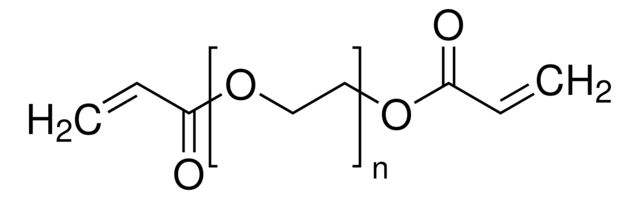
Poly(ethylene glycol) diacrylate
average Mn 10,000, acrylate, MEHQ as inhibitor (may contain)
Manufacturer: Sigma Aldrich
CAS Number: 26570-48-9
Synonym(S): Polyethylene glycol, PEG diacrylate
Select a Size
| Pack Size | SKU | Availability | Price |
|---|---|---|---|
| 1 G | 729094-1-G | In Stock | ₹ 11,233.20 |
729094 - 1 G
In Stock
Quantity
1
Base Price: ₹ 11,233.20
GST (18%): ₹ 2,021.976
Total Price: ₹ 13,255.176
product name
Poly(ethylene glycol) diacrylate, average Mn 10,000, contains MEHQ as inhibitor
form
solid
Quality Level
100
mol wt
average Mn 10,000
contains
MEHQ as inhibitor≤1,500 ppm MEHQ as inhibitor (may contain)
reaction suitability
reagent type: cross-linking reagentreaction type: Polymerization Reactions
transition temp
Tm 60-64 °C
Mw/Mn
<1.1
Ω-end
acrylate
α-end
acrylate
Other Options
| Image | Product Name | Manufacturer | Price Range | |
|---|---|---|---|---|
Sigma Aldrich Fine Chemicals Biosciences Poly(ethylene glycol) diacrylate | 26570-48-9 | MFCD00081876 | 100mL | -- | ₹ 6,725.02 | ||
Sigma Aldrich Fine Chemicals Biosciences Poly(ethylene glycol) diacrylate|26570-48-9 | MFCD00081876 | 100ml | -- | ₹ 6,981.70 | ||
Sigma Aldrich Fine Chemicals Biosciences Poly(ethylene glycol) diacrylate | 26570-48-9 | MFCD00081876 | 100ml | -- | ₹ 7,212.71 | ||
Sigma Aldrich Fine Chemicals Biosciences Poly(ethylene glycol) diacrylate average Mn 700 | 26570-48-9 | MFCD00081876 | 500ML | -- | ₹ 14,463.92 | ||
Poly(ethylene glycol) diacrylate | -- | ₹ 6,679.03 - ₹ 14,375.60 | ||
Poly(ethylene glycol) diacrylate | -- | ₹ 7,826.48 - ₹ 11,723.48 | ||
Poly(ethylene glycol) diacrylate | -- | ₹ 7,231.10 - ₹ 15,501.40 | ||
Poly(ethylene glycol) diacrylate | -- | ₹ 11,233.20 | ||
Poly(ethylene glycol) diacrylate | -- | ₹ 7,155.33 | ||
Poly(ethylene glycol) diacrylate | -- | ₹ 16,638.03 |
Related Products
Description
- Application: 3D Bioprinting of Hydrogels: This study explores the formulation of PEGDA-based hydrogels for 3D bioprinting, focusing on rheological properties and structural fidelity, particularly relevant for tissue engineering applications (Wu et al., 2018). Sustained Ocular Drug Delivery: Investigates the delivery of small and large drug molecules using PEGDA implants, highlighting the implications for sustained drug release in ocular therapies (McAvoy et al., 2018). Tissue Engineering Scaffolds: Evaluates PEGDA-polycaprolactone scaffolds for tissue engineering, emphasizing the control over porosity and its importance for regenerative medicine applications (Kotturi et al., 2017). Photocrosslinked Hydrogel Implants: Focuses on photocrosslinked PEGDA implants for drug delivery, providing insights into the design of drug delivery systems that can be finely tuned for specific therapeutic needs (Qin et al., 2015). Hydrogel-Based Artificial Muscles: Characterizes PEGDA/acrylic acid hydrogels optimized for use as artificial muscles, highlighting their potential in biomedical engineering and smart materials (Browe et al., 2017).
- Preparation Note: Synthesized with an initial concentration of ≤1,500 ppm MEHQ
SAFETY INFORMATION
Pictograms
Signal Word
Danger
Hazard Statements
Precautionary Statements
P261 - P264 - P272 - P280 - P302 + P352 - P305 + P351 + P338
Hazard Classifications
Eye Dam. 1 - Skin Irrit. 2 - Skin Sens. 1
WGK
WGK 1
Flash Point(F)
Not applicable
Flash Point(C)
Not applicable