PI16129
Thermo Scientific™ EZ-Link™ NHS-Desthiobiotin
Manufacturer: Thermo Scientific™
Select a Size
| Pack Size | SKU | Availability | Price |
|---|---|---|---|
| Each of 1 | PI16129-Each-of-1 | In Stock | ₹ 29,175.96 |
PI16129 - Each of 1
In Stock
Quantity
1
Base Price: ₹ 29,175.96
GST (18%): ₹ 5,251.673
Total Price: ₹ 34,427.633
Product Type
NHS-Desthiobiotin
Content And Storage
Store at -20°C.
Cell Permeability
Cell-Permeant
Reactive Moiety
Active Ester, Succinimidyl Ester, NHS Ester
Label or Dye
Biotin Analog
Label Type
Biotin & Analogs
Quantity
50 mg
Product Line
EZ-Link™
Chemical Reactivity
Amine
Solubility
DMF (Dimethylformamide), DMSO (Dimethylsulfoxide)
Spacer
Short
Related Products





Description
- Thermo Scientific EZ-Link NHS-Desthiobiotin is a short, membrane permeable, amine-reactive labeling reagent whose biotin-like group is elutable from streptavidin, making it ideal for intracellular protein labeling and purification
- NHS-Desthiobiotin is a variant of biotin that is activated as an NHS ester to covalently label primary amines (-NH2) of proteins or other molecules with desthiobiotin groups
- The desthiobiotin tag binds to streptavidin and other biotin-binding proteins with high specificity yet readily elutes with mild conditions (i.e., by competitive displacement with regular, free biotin)
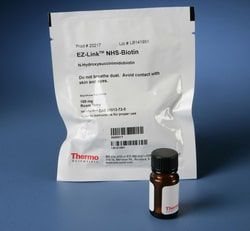
- As such, this reagent is a useful alternative to NHS-Biotin (Part No
- 20217) for avidin-biotin techniques in which nondenaturing elution of the labeled proteins is desired
- This simplest and smallest variety of amine-reactive desthiobiotin reagent is uncharged and cell membrane permeable; therefore, NHS-Desthiobiotin can be used with intact cells for intracellular protein labeling
- Highlights: Desthiobiotin - analog of biotin allows easy elution from streptavidin, an ideal feature for affinity purification applications Protein labeling - tag antibodies or proteins in purified or mixed samples to enable high recovery in pull-down assays with streptavidin beads Membrane-permeable - achieve intracellular labeling with intact cells because the small, uncharged reagent easily diffuses across cell membranes Amine-reactive - reacts with primary amines (-NH2), such as the side-chain of lysines (K) or the amino-termini of polypeptides Desthiobiotin vs
- Biotin: Desthiobiotin is a single-ring, sulfur-free analog of biotin that binds to streptavidin with nearly equal specificity but less affinity than biotin (1/Kd = 10^11 vs
- 10^15M, respectively)[1-2]
- Consequently, desthiobiotinylated bait proteins and their interacting partners can be eluted readily and specifically from streptavidin affinity resin using mild conditions based on competitive displacement with free biotin
- For pull-down assay experiments with biological samples, this soft-release characteristic of desthiobiotin also helps to minimize co-purification of endogenous biotinylated molecules, which remain bound to streptavidin upon elution of the target protein complexes with free biotin
- The modified avidin-biotin affinity system also eliminates the need to use harsh elution conditions that might disassociate complexes and/or damage the target protein or cell
- Desthiobiotin-based techniques are ideal when using native or recombinant proteins that are not expressed with a fusion tag and when isolating captured proteins under native conditions, such as targeting intact cells or cell surface proteins
- Labeling with NHS Ester Reagents: N -Hydroxysulfosuccinimide (NHS) esters of biotin are the most popular type of biotinylation reagent
- NHS-activated biotins react efficiently with primary amino groups (-NH2) in alkaline buffers to form stable amide bonds
- Proteins typically have several primary amines that are available as targets for labeling, including the side chain of lysine (K) residues and the N-terminus of each polypeptide
- Most sulfo-NHS esters are directly water soluble but not membrane permeable
- Plain NHS esters are less soluble in aqueous buffers but are membrane permeable.