PI23225
Thermo Scientific™ Pierce™ BCA Protein Assay Kits
Manufacturer: Fischer Scientific
Select a Size
| Pack Size | SKU | Availability | Price |
|---|---|---|---|
| Pack of 1 | PI23225-Pack-of-1 | In Stock | ₹ 29,133.18 |
PI23225 - Pack of 1
In Stock
Quantity
1
Base Price: ₹ 29,133.18
GST (18%): ₹ 5,243.972
Total Price: ₹ 34,377.152
Concentration
BSA: 2 mg/mL
Assay
BCA Assay
Product Line
Pierce™
Specificity
Not Target-Specific
For Use With (Application)
Solution-based Detection, Absorbance
Kit Contents
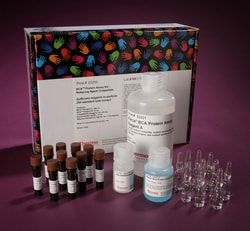
10 x 1 mL glass ampules
Content And Storage
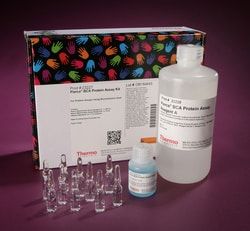
Sufficient For: 500 tube assays or 5000 microplate assays• BCA Reagent A, 2 x 500 mL• BCA Reagent B, 25 mL• Albumin Standard Ampules, 2 mg/mL, 10 x 1 mLStore at room temperature
Detection Method
Colorimetric
Product Type
Protein Quantitation Assay
Sufficient For
500 Tube Assays or 5000 Microplate Assays
For Use With (Equipment)
Spectrophotometer, Microplate Reader
Quantity
1 Kit (1 L)
Related Products


Description
- The Pierce BCA Protein Assay Kit is a high-precision, detergent-compatible protein assay for determination of protein concentration
- Pierce BCA reagents provide accurate determination of protein concentration with most sample types encountered in protein research
- The Pierce BCA assay can be used to assess yields in whole cell lysates, affinity-column fractions, purified proteins samples, as well as to monitor protein contamination in industrial applications
- Compared to most dye-binding methods, the BCA assay is affected much less by protein compositional differences, providing greater concentration accuracy
- Kits are available with or without Pierce Dilution-Free BSA Protein Standards, which are a set of seven pre-diluted BSA standards, packaged in a multichannel pipette-friendly tubestrip
- The tubestrip includes a single empty tube that enables users to add their own sample buffer for the purpose of blank subtraction
- The Pierce BCA Protein Assay Kit is a high-precision, detergent-compatible protein assay for determination of protein concentration
- Pierce BCA reagents provide accurate determination of protein concentration with most sample types encountered in protein research
- The Pierce BCA assay can be used to assess yields in whole cell lysates, affinity-column fractions, purified proteins samples, as well as to monitor protein contamination in industrial applications
- Compared to most dye-binding methods, the BCA assay is affected much less by protein compositional differences, providing greater concentration accuracy
- Kit options are available that include Pierce Dilution-Free BSA Protein Standards, which are a set of seven pre-diluted BSA standards, packaged in a multichannel pipette-friendly tubestrip. The tubestrip includes a single empty tube that enables users to add their own sample buffer for the purpose of blank subtraction
- Features of the BCA Protein Assay Kit include: Colorimetric —estimate visually or measure with a standard spectrophotometer or plate reader at 562 nm Accurate —exhibits half the protein-to-protein variation observed with dye-binding methods (Bradford) Compatible —unaffected by typical concentrations of most ionic and non-ionic detergents Short assay time —30-min incubation; much easier and four times faster than classical Lowry methods Wide assay range —linear working range for BSA of 20 to 2000 μg/mL Sensitive —detect down to 5 μg/mL with enhanced protocol No more serial dilutions —kit options include Dilution-Free BSA Protein Standards which eliminate the need to perform serial dilutions when generating a standard curve How the assay works The BCA Protein Assay combines the well-known reduction of Cu 2+ to Cu 1+ by protein in an alkaline medium with the highly sensitive and selective colorimetric detection of the cuprous cation (Cu 1+ ) by bicinchoninic acid (BCA)
- The first step is the chelation of copper with protein in an alkaline environment to form a light blue complex
- In this reaction, known as the biuret reaction, peptides containing three or more amino acid residues form a colored chelate complex with cupric ions in an alkaline environment containing sodium potassium tartrate
- In the second step of the color development reaction, BCA reacts with the reduced (cuprous) cation that was formed in step one
- The intense purple-colored reaction product results from the chelation of two molecules of BCA with one cuprous ion
- The BCA/copper complex is water soluble and exhibits a strong linear absorbance at 562 nm with increasing protein concentrations
- The complex is approximately 100 times more sensitive (lower limit of detection) than the pale blue color of the first reaction
- The reaction is strongly influenced by four amino acid residues (cysteine, cystine, tyrosine, and tryptophan) in the amino acid sequence of the protein
- However, unlike Coomassie dye-binding methods (i.e., Bradford), the universal peptide backbone also contributes to color formation, helping to minimize variability caused by protein compositional differences.