S2002
Sodium azide
ReagentPlus®, ≥99.5%
Manufacturer: Sigma Aldrich
CAS Number: 26628-22-8
Synonym(S): Hydrazoic acid sodium salt
Select a Size
| Pack Size | SKU | Availability | Price |
|---|---|---|---|
| 5 G | S2002-5-G | In Stock | ₹ 2,197.48 |
| 25 G | S2002-25-G | In Stock | ₹ 5,011.98 |
| 100 G | S2002-100-G | In Stock | ₹ 5,639.83 |
| 500 G | S2002-500-G | In Stock | ₹ 25,471.23 |
| 2 KG | S2002-2-KG | In Stock | ₹ 77,853.40 |
| 25 KG | S2002-25-KG | In Stock | ₹ 6,38,707.48 |
S2002 - 5 G
In Stock
Quantity
1
Base Price: ₹ 2,197.48
GST (18%): ₹ 395.546
Total Price: ₹ 2,593.026
biological source
synthetic (inorganic)
Quality Level
200
product line
ReagentPlus®
Assay
≥99.5%
form
powder
storage condition
(Tightly closed. Dry. Keep in a well-ventilated place. Do not store near acids.)
technique(s)
cell based assay: suitableimmunohistochemistry: suitable
color
white
mp
370-425 °C
solubility
soluble 65 g/L at 20 °C (completely)
Other Options
Related Products
Description
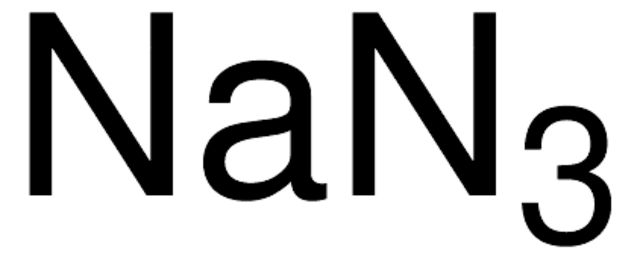
- General description: Sodium Azide (NaN3) is a potent inhibitor – a water-soluble crystalline powder that′s odorless. Widely recognized for its versatile applications, it plays a pivotal role across molecular biology, cell culture, and biochemical research. Sodium azide is commonly used as a bacteriostatic preservative in aqueous laboratory reagents and biological fluids. It is also a metabolic inhibitor, which inhibits oxidative phosphorylation. In cell culture, it maintains the integrity of your cell lines by preventing microbial contamination. Its application extends to molecular biology, where it aids in preserving nucleic acids for downstream analysis, ensuring the fidelity of your results.
- Application: Baylis-Hillman acetates such as ethyl 2-(acetoxyphenylmethyl)acrylate can undergo nucleophilic displacement by sodium azide in aqueous medium to form ethyl (E)-2-azidomethyl-3-phenylpropenoate.[1]
- Biochem/physiol Actions: Sodium azide is clinically used as a preservative in diluting fluid for counting red blood cells.[10] It prevents capping and internalization of fluorescent surface-bound antibodies in various scientific applications, including flow cytometry.[11]
- Other Notes: For additional information on our range of Biochemicals, please complete this form.
- Legal Information: ReagentPlus is a registered trademark of Merck KGaA, Darmstadt, Germany
SAFETY INFORMATION
Pictograms
Signal Word
Danger
Hazard Statements
Precautionary Statements
P262 - P264 - P273 - P280 - P302 + P352 + P310 - P304 + P340 + P310
Hazard Classifications
Acute Tox. 1 Dermal - Acute Tox. 2 Inhalation - Acute Tox. 2 Oral - Aquatic Acute 1 - Aquatic Chronic 1 - STOT RE 2 Oral
Target Organs
Brain
Supplementary Hazards
EUH032
WGK
WGK 2
Flash Point(F)
Not applicable
Flash Point(C)
Not applicable