A7094
L-Asparagine monohydrate
≥98.0%, suitable for cell culture, BioReagent, non-animal source
Manufacturer: Sigma Aldrich
CAS Number: 5794-13-8
Synonym(S): Asparagine monohydrate, (S)-(+)-2-Aminosuccinamic acid, (S)-2-Aminosuccinic acid 4-amide, L-Aspartic acid 4-amide
Select a Size
| Pack Size | SKU | Availability | Price |
|---|---|---|---|
| 25 G | A7094-25-G | In Stock | ₹ 4,546.50 |
| 100 G | A7094-100-G | In Stock | ₹ 8,075.45 |
| 1 KG | A7094-1-KG | In Stock | ₹ 37,660.18 |
A7094 - 25 G
In Stock
Quantity
1
Base Price: ₹ 4,546.50
GST (18%): ₹ 818.37
Total Price: ₹ 5,364.87
biological source
non-animal source
Quality Level
300
product line
BioReagent
Assay
≥98.0%
form
powder
optical activity
[α]20/D 33.0 to 36.3 °, c = 10 in 6 M HCl
technique(s)
cell culture | mammalian: suitable
impurities
endotoxin, tested
color
white
mp
233-235 °C (lit.)
Other Options
| Image | Product Name | Manufacturer | Price Range | |
|---|---|---|---|---|
Sigma Aldrich Fine Chemicals Biosciences L-Asparagine monohydrate >=99% (TLC) | 5794-13-8 | MFCD00151038 | 1KG | -- | ₹ 50,411.95 | ||
Sigma Aldrich Fine Chemicals Biosciences L-Asparagine monohydrate from non-animal source, BioReagent, suitable for cell culture | 5794-13-8 | MFCD00151038 | 100g | -- | ₹ 12,682.56 | ||
Sigma Aldrich Fine Chemicals Biosciences L-Asparagine monohydrate from non-animal source, BioReagent, suitable for cell culture, >=98.0% | 5794-13-8 | MFCD00151038 | 25G | -- | ₹ 7,837.30 | ||
Sigma Aldrich Fine Chemicals Biosciences L-Asparagine monohydrate suitable for cell culture, BioReagent | 5794-13-8 | MFCD00151038 | 1KG | -- | ₹ 61,192.51 | ||
Asparagine monohydrate | -- | ₹ 45,854.70 | ||
L-Asparagine monohydrate | -- | ₹ 6,343.45 - ₹ 25,417.10 | ||
L-Asparagine monohydrate | -- | ₹ 5,217.65 - ₹ 52,479.60 | ||
L-Asparagine monohydrate | -- | ₹ 1,08,625.63 - ₹ 4,16,273.21 | ||
L-Asparagine monohydrate | -- | ₹ 6,343.45 - ₹ 25,417.10 | ||
L-Asparagine monohydrate | -- | ₹ 4,546.50 - ₹ 37,660.18 |
Related Products
Description
- General description: L-Asparagine is a naturally occurring amino acid found in various proteins. It is used in laboratory research for various applications, including cell culture, protein biochemistry, and nitrogen metabolism studies. Its solubility in water and role as a source of asparagine make it a versatile tool for investigating biological processes and chemical synthesis. Further, L-Asparagine residues in proteins can be crucial for protein stability, folding, and interactions.
- Application: L-Asparagine is used in cell culture media and is a component of MEM non-essential amino acids solution. L-Asparagine has been shown to enhance ornithine decarboxylase activity in cultured human colon adenocarcinoma Caco-2 cells and in cultured IEC-6 intestinal epithelial cells. Spore germination in Bacillus subtilis has been increased in the presence of L-asparagine. L-Asparagine, a proteinogenic amino acid, from non-animal source is used in biomanufacturing cell culture systems for the production of therapeutic recombinant proteins and monoclonal antibodies. It has also been used as a component of LHC basal media for the culture of human airway epithelial cells.[1]
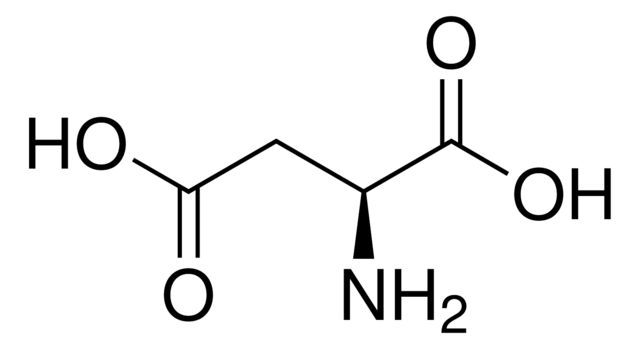
- Biochem/physiol Actions: The amino acid L-asparagine is a structural analog of L-aspartic acid, where the side chain of the carboxylic acid moiety is amidated to give a terminal amine group.[2] This renders L-asparagine neutral at physiological pH. The amide group of asparagine is derived from glutamine,[3] in the reaction of aspartate and glutamine in the presence of ATP to yield asparagine and glutamate. In vivo, asparagine is hydrolyzed to aspartate and NH4+ by asparaginase.[4] Asparagine is also an important amino acid in glycopeptide bonds, via N-glycosyl linkages to the sugar rings.
- Features and Benefits: Suitable for Cell Culture and Biochemical researchHigh-quality compound suitable for multiple research applications
- Other Notes: For additional information on our range of Biochemicals, please complete this form.
SAFETY INFORMATION
WGK
WGK 1
Flash Point(F)
Not applicable
Flash Point(C)
Not applicable
Personal Protective Equipment
dust mask type N95 (US), Eyeshields, Gloves