H8384
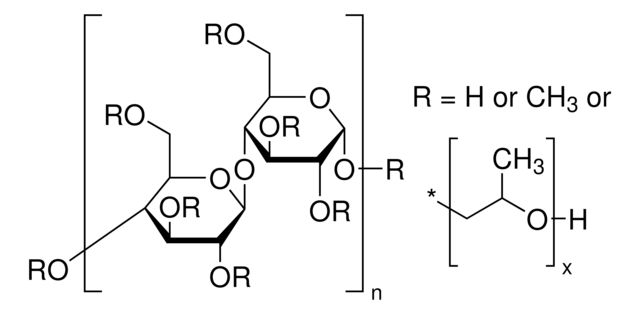
(Hydroxypropyl)methyl cellulose
viscosity 40-60 cP, 2 % in H2O(20 °C)(lit.)
Manufacturer: Sigma Aldrich
CAS Number: 9004-65-3
Synonym(S): 2-Hydroxypropyl methyl cellulose ether
Select a Size
| Pack Size | SKU | Availability | Price |
|---|---|---|---|
| 25 G | H8384-25-G | In Stock | ₹ 6,765.63 |
| 100 G | H8384-100-G | In Stock | ₹ 14,895.20 |
| 250 G | H8384-250-G | In Stock | ₹ 30,190.93 |
H8384 - 25 G
In Stock
Quantity
1
Base Price: ₹ 6,765.63
GST (18%): ₹ 1,217.813
Total Price: ₹ 7,983.443
form
powder
Quality Level
200
mol wt
~22 kDa
color
beige
viscosity
40-60 cP, 2 % in H2O(20 °C)(lit.)
solubility
water: 10 mg/mL, clear to slightly hazy
storage temp.
room temp
Other Options
| Image | Product Name | Manufacturer | Price Range | |
|---|---|---|---|---|
Sigma Aldrich Fine Chemicals Biosciences (Hydroxypropyl)methyl cellulose average Mn ~120,000 | 9004-65-3 | MFCD00131360 | 100G | -- | ₹ 15,512.03 | ||
Sigma Aldrich Fine Chemicals Biosciences (Hydroxypropyl)methyl cellulose | 9004-65-3 | MFCD00131360 | 25g | -- | ₹ 7,118.59 | ||
Sigma Aldrich Fine Chemicals Biosciences (Hydroxypropyl)methyl cellulose average Mn ~10,000 | 9004-65-3 | MFCD00131360 | 100G | -- | ₹ 15,512.03 | ||
Sigma Aldrich Fine Chemicals Biosciences Hypromellose meets USP testing specifications | 9004-65-3 | MFCD00131360 | 25g | -- | ₹ 7,708.96 | ||
Hypromellose | -- | ₹ 29,086.78 | ||
Hypromellose | -- | ₹ 45,854.70 | ||
(Hydroxypropyl)methyl cellulose | -- | ₹ 7,144.50 - ₹ 35,906.53 | ||
(Hydroxypropyl)methyl cellulose | -- | ₹ 6,520.00 - ₹ 35,343.63 | ||
(Hydroxypropyl)methyl cellulose | -- | ₹ 6,051.18 - ₹ 39,164.85 | ||
Hypromellose | -- | ₹ 7,600.00 - ₹ 40,540.00 |
Related Products


Description
- Application: Thickener for aqueous and non-aqueous systems, clear films with grease resistance, binders, lubricants, steric stabilizer and water retention aid.
- Features and Benefits: Dissolves in water, undergoes reversible gelation upon heating, non-ionic, does not complex with ionic species and is surface active and enzyme resistant. Solutions are pseudoplastic.
- Quality: Normally contains some iron particles.
- Preparation Note: This product is soluble in water (10 mg/ml). However, it is very important to thoroughly disperse the particles in water with agitation before they will dissolve. Otherwise, they will lump and form a gelatinous membrane around the internal particles, preventing them from wetting completely. There are four dispersion techniques commonly used to prepare solutions of hydroxypropylmethylcellulose: dispersion in hot water, dry blending, dispersion in non-solvent medium, and dispersion of surface-treated powders. (The last method is only for surface-treated powders). Dispersion in hot water:1. Heat approximately 1/3 the required volume of water to at least 90 oC. 2. Add the powder to the heated water with stirring or agitation.3. Agitate the mixture until the particles are thoroughly wetted and evenly dispersed.4. Add the remainder of the water (cold water) to lower the temperature of the dispersion. As the product cools, it will reach a temperature at which it becomes water soluble. It will then begin to hydrate and dissolve, increasing the viscosity of the solution.5. Continue agitation for at least 30 minutes after the proper temperature is reached for solubility. The solution is now ready to use.Dry blending:1. Combine powder with other dry ingredients. The suggested ratio of dry powder to hydroxypropylmethylcellulose is 7:1 to 3:1.2. Thoroughly blend the dry ingredients.3. Add the dry mixture to water with agitation.4. Agitate until the product has completed hydrated and the solution is consistently smooth. The solution is now ready for further processing/use.Dispersion in non-solvent medium:1. Hydroxypropylmethylcellulose may be dispersed in non-solvent media such as vegetable oil, polyethylene glycol, glycerin, corn syrup, and concentrated salt solutions. A ratio of 5-8 parts non-solvent to 1 part hydroxypropylmethylcellulose is recommended to obtain a liquid slurry.2. Agitate the mixture until the particles are evenly dispersed.3. This dispersion may be added to cold water or cold water may be added to the dispersion.4. Continue mixing until the powder is completely hydrated and the solution is smooth. Additional ingredients may now be added to the formulation.
- Other Notes: To gain a comprehensive understanding of our extensive range of Polysaccharides for your research, we encourage you to visit our Carbohydrates Category page.
SAFETY INFORMATION
WGK
WGK 1
Flash Point(F)
Not applicable
Flash Point(C)
Not applicable
Personal Protective Equipment
dust mask type N95 (US), Eyeshields, Gloves