M4287
Mitomycin C from Streptomyces caespitosus
powder, suitable for cell culture, BioReagent
Manufacturer: Sigma Aldrich
CAS Number: 50-07-7
Synonym(S): Mitomycin
Select a Size
| Pack Size | SKU | Availability | Price |
|---|---|---|---|
| 2 MG | M4287-2-MG | In Stock | ₹ 17,612.28 |
| 5 X 2 MG | M4287-5-X-2-MG | In Stock | ₹ 78,730.23 |
M4287 - 2 MG
In Stock
Quantity
1
Base Price: ₹ 17,612.28
GST (18%): ₹ 3,170.21
Total Price: ₹ 20,782.49
biological source
Streptomyces caespitosus
Quality Level
200
product line
BioReagent
form
powder
technique(s)
cell culture | mammalian: suitable
color
gray purple/blue
(1) 3.2, (2) 6.5
solubility
H2O: 4 mL/vial, clear to slightly hazy, blue to purple (Stock solutions should be filter sterilized and stored at 2-8 °C in the dark.)
antibiotic activity spectrum
Gram-negative bacteriaGram-positive bacteria
Mode of action
DNA synthesis | interferes
Other Options
| Image | Product Name | Manufacturer | Price Range | |
|---|---|---|---|---|
Cayman Chemical Mitomycin C | 50-07-7 | MFCD00078109 | 5mg | -- | ₹ 6,100.43 | ||
Selleck Chemical LLC Mitomycin C 10mg 50-07-7 | -- | ₹ 20,226.38 | ||
Selleck Chemical LLC Mitomycin C 50mg 50-07-7 | -- | ₹ 48,158.30 | ||
Sigma Aldrich Fine Chemicals Biosciences Mitomycin United States Pharmacopeia (USP) Reference Standard | 50-07-7 | 50MG | -- | ₹ 1,38,316.30 | ||
Biomatik Corporation Mitomycin C. Grade Biotechnology. Storage 4C. CAS 50-07-7 | -- | ₹ 30,285.67 | ||
Enzo Life Sciences Mitomycin C (10mg). CAS: 50-07-7 | -- | ₹ 17,710.92 | ||
Mitomycin | -- | ₹ 1,25,342.68 | ||
Mitomycin | -- | ₹ 20,567.50 | ||
Mitomycin C | -- | ₹ 8,248.65 | ||
Mitomycin C from Streptomyces caespitosus | -- | ₹ 12,557.00 |
Related Products
Description
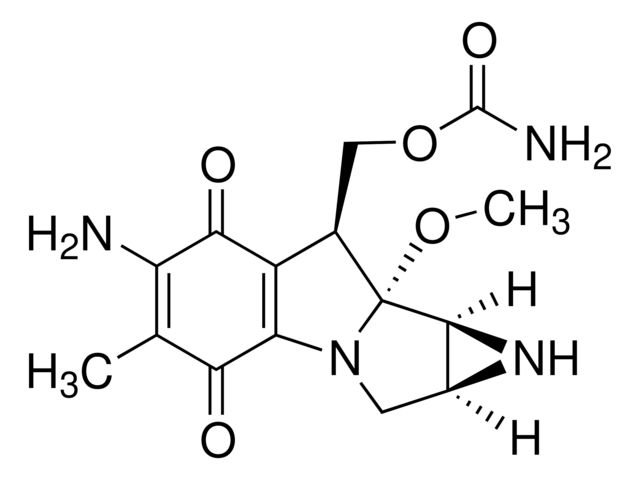
- General description: Mitomycin C is a systemic chemotherapy compound and an antibiotic obtained from Streptomyces caespitosus.[1][2] It is the first bioreductive alkylating agent to be identified and is a derivative of 3-amino-5-hydroxybenzoic acid (AHBA), D-glucosamine, L-methionine and carbamoyl phosphate.[3]Chemical structure: Aziridine
- Application: Mitomycin C from Streptomyces caespitosus has been used for the treatment of feeder layers such as, PMEF (primary mouse embryonic fibroblasts) and CD1 mouse embryonic fibroblasts (MEFs) for the culture of hESCs (human embryonic stem cells).[4][5][6] It has also been used for the treatment of BLC (basal-like cancer) cell line.[7]
- Biochem/physiol Actions: Mitomycin C causes the cross-linking of double-stranded DNA, which results in mutagenesis, inhibition of DNA synthesis, initiation of DNA repair events, and activation of apoptosis. The capability to inhibit DNA synthesis is attributable to the aminoquinone group present in mitomcyin C.[3][8] This compound does not affect the synthesis of RNA and protein. In tissue culture, this compound decreases cell viability and suppresses mitosis, and causes disorganization of nucleus and the production of giant cells.[2] Mitomycin C has potent anti-Gram negative and anti-Gram positive activities.[8] It contains three moieties, quinine, urethane, and aziridine groups. It is used to generate mitotically inactive feeder cells in cell culture systems, such as the mitotically inactive fibroblasts used in embryonic stem cell systems.
- Caution: This vial contains 2 mg Mitomycin C and 48 mg NaCl. Stock solutions should be filter sterilized and stored at 2-8°C in the dark. Solutions at pH 6-9 can be stored at 0-5°C for up to a week, but if a precipitate forms, a fresh solution should be prepared - the precipitated solution has been proven toxic to cells.
- Preparation Note: Mitomycin C is soluble in water at .5 mg/mL, with a pH of 6.0-7.5. It undergoes rapid degradation in acidic solutions with pH<6, and is mostly likely to retain activity in solutions with a pH between 6-9.
SAFETY INFORMATION
Pictograms
Signal Word
Warning
Hazard Statements
Precautionary Statements
Hazard Classifications
Acute Tox. 4 Oral - Carc. 2
WGK
WGK 3
Flash Point(F)
Not applicable
Flash Point(C)
Not applicable