T6791
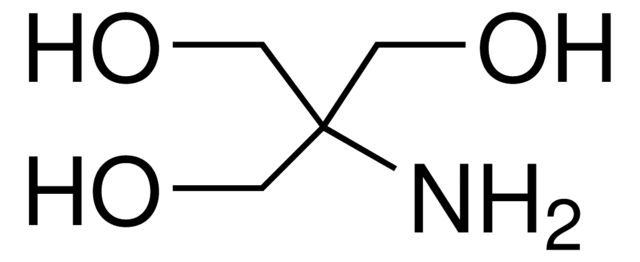
Trizma® base
Manufacturer: Sigma Aldrich
CAS Number: 77-86-1
Synonym(S): 2-Amino-2-(hydroxymethyl)-1,3-propanediol, THAM, Tris base, Tris(hydroxymethyl)aminomethane, Trometamol
Select a Size
| Pack Size | SKU | Availability | Price |
|---|---|---|---|
| 100 G | T6791-100-G | In Stock | ₹ 12,004.93 |
| 500 G | T6791-500-G | In Stock | ₹ 28,015.10 |
| 1 KG | T6791-1-KG | In Stock | ₹ 54,211.60 |
T6791 - 100 G
In Stock
Quantity
1
Base Price: ₹ 12,004.93
GST (18%): ₹ 2,160.887
Total Price: ₹ 14,165.817
description
aminopeptidase substrate
Quality Level
400
product line
BioXtra
Assay
≥99.9% (titration)
form
crystalline
storage condition
dry at room temperature
impurities
≤0.005% Insoluble matter
ign. residue (900 °C)
≤0.01% (as SO4)
loss
≤0.5% loss on drying, 110°C
color
white
Other Options
...
Related Products
Description
- General description: Tris base, also referred as THAM or Trizma® base, plays a vital role in various research applications as a biological buffer. It is commonly employed in buffer formulations like TAE and TBE buffers, thanks to its pKa of 8.06, which makes it suitable for maintaining pH within the physiological range (pH 7.0-9.0) for most living organisms. However, it is important to exercise caution when studying proteins, as Tris may interfere with the activity of certain enzymes. This versatile compound is indispensable in laboratories, where it is utilized to prepare buffers compatible with biological fluids, serve as a standard pH solution, and facilitate procedures such as lactate dehydrogenase assays, in situ hybridization, and protein extraction from cells. Moreover, Tris base finds applications in biochemistry and molecular biology labs aiding in cell membrane permeability studies and buffer preparation.
- Application: Tris buffer has been used to stabilize the pH, facilitating the measurement of cytotoxicity using the sulforhodamine B (SRB) colorimetric cytotoxicity assay in cancer research[1]. Additionally, it was utilized in this study to regulate the pH of the incubation medium to assess the glucose secretion as a response mediated by glucocorticoids in metabolic pathways[2].
- Features and Benefits: Suitable for Cell Membrane permeability studies and for buffer preparation in Biochemical and Molecular Biology ResearchTested to confirm low levels of heavy metal contamination, ensuring suitability for various applicationsEffective Buffering from pH 7-9 (25 °C) with a pKa of 8.1 (25 °C)Tested for the presence of Anionic and Cationic traces
- Other Notes: The pH values of all buffers are temperature- and concentration-dependent. For Tris buffers, pH increases about 0.03 unit per °C decrease in temperature, and decreases 0.03-0.05 unit per ten-fold dilution.For precise applications, use a carefully calibrated pH meter with a glass/calomel combination electrode.
- Legal Information: Trizma is a registered trademark of Merck KGaA, Darmstadt, Germany
SAFETY INFORMATION
WGK
WGK 1
Flash Point(F)
Not applicable
Flash Point(C)
Not applicable
Personal Protective Equipment
dust mask type N95 (US), Eyeshields, Gloves