202371
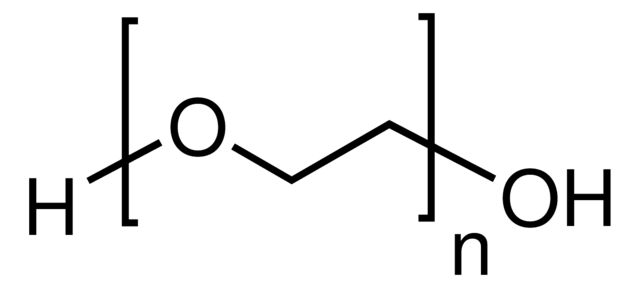
Poly(ethylene glycol)
average Mn 300, hydroxyl
Manufacturer: Sigma Aldrich
CAS Number: 25322-68-3
Synonym(S): Polyethylene glycol, PEG
Select a Size
| Pack Size | SKU | Availability | Price |
|---|---|---|---|
| 250 G | 202371-250-G | In Stock | ₹ 4,459.90 |
| 500 G | 202371-500-G | In Stock | ₹ 5,953.75 |
| 1 KG | 202371-1-KG | In Stock | ₹ 7,664.10 |
| 20 KG | 202371-20-KG | In Stock | ₹ 1,04,905.08 |
202371 - 250 G
In Stock
Quantity
1
Base Price: ₹ 4,459.90
GST (18%): ₹ 802.782
Total Price: ₹ 5,262.682
product name
Poly(ethylene glycol), average Mn 300
form
viscous liquid
Quality Level
200
mol wt
Mn 285-315average Mn 300
refractive index
n20/D 1.463
pH
6-7 (23 °C, at 10 g/l)
viscosity
5.8 cSt(210 °F)(lit.)
mp
−15-−8 °C (lit.)
density
1.125 g/mL at 25 °C
Mw/Mn
1.1 (typical)
Other Options
| Image | Product Name | Manufacturer | Price Range | |
|---|---|---|---|---|
RIGAKU REAGENTS PEG 1000, 50%(w/v), 100 ml, CAS# 25322-68-3 | -- | ₹ 7,803.07 | ||
Electron Microscopy Sciences Carbowax Polyethylene Glycol, PEG 400 viscous liquid, 25322-68-3, 450ml | -- | ₹ 4,072.66 | ||
RIGAKU REAGENTS PEG 4000, 50%(w/v), 250 ml, CAS # 25322-68-3 | -- | ₹ 13,347.36 | ||
RIGAKU REAGENTS PEG 6000, 50%(w/v), 250 ml, CAS# 25322-68-3 | -- | ₹ 13,347.36 | ||
Medchemexpress LLC HY-Y0873 50mL , PEG300 CAS:25322-68-3 Purity:>98% | -- | ₹ 4,491.90 | ||
eMolecules PEG4000 | 25322-68-3 | MFCD00002882 | 100g | -- | ₹ 6,297.22 | ||
Poly(ethylene glycol) for GPC 108,000, MilliporeSigma™ Supelco™ | -- | ₹ 1,00,361.88 | ||
Poly(ethylene glycol) for GPC 12,000, MilliporeSigma™ Supelco™ | -- | ₹ 23,785.68 | ||
Poly(ethylene glycol) for GPC 20,000, MilliporeSigma™ Supelco™ | -- | ₹ 23,914.02 | ||
Poly(ethylene glycol) for GPC 200, MilliporeSigma™ Supelco™ | -- | ₹ 24,598.50 |
...
Related Products
Description
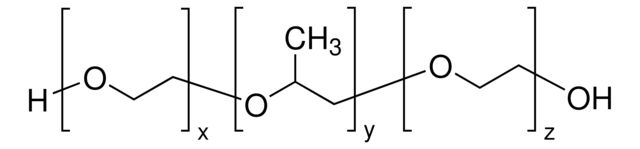
- General description: Polyethylene glycol (PEG) is a hydrophilic polymer. It can be easily synthesized by the anionic ring opening polymerization of ethylene oxide, into a range molecular weights and variety of end groups. When crosslinked into networks, PEG can have high water content, forming "hydrogels". Hydrogel formation can be initiated by either crosslinking PEG by ionizing radiation or by covalent crosslinking of PEG macromers with reactive chain ends. PEG is a suitable material for biological applications because it does not trigger an immune response.
- Application: PEG modification increases thermostability and inhibitor resistance of Bst DNA polymerase.: This study demonstrates that polyethylene glycol (PEG) modification significantly enhances the thermostability and inhibitor resistance of Bst DNA polymerase, highlighting PEG′s potential in improving enzyme performance for biotechnological applications (Yang et al., 2024).Development of Lyophilized Eukaryotic Cell-Free Protein Expression System Based on Leishmania tarentolae.: The incorporation of PEG in the lyophilization process of a cell-free protein expression system demonstrates its role in enhancing the stability and efficiency of biotechnological workflows (Alfaro-Palma et al., 2024).A comprehensive review on singlet oxygen generation in nanomaterials and conjugated polymers for photodynamic therapy in the treatment of cancer.: This review highlights the application of PEGylated nanomaterials in photodynamic therapy, emphasizing its significance in improving biocompatibility and therapeutic efficacy in cancer treatments (Singh et al., 2024).
SAFETY INFORMATION
WGK
WGK 1
Flash Point(F)
closed cup
Flash Point(C)
closed cup
Personal Protective Equipment
dust mask type N95 (US), Eyeshields, Gloves