202444
Poly(ethylene glycol)
average MN 3,350, hydroxyl, powder
Manufacturer: Sigma Aldrich
CAS Number: 25322-68-3
Synonym(S): Polyethylene glycol, PEG
Select a Size
| Pack Size | SKU | Availability | Price |
|---|---|---|---|
| 250 G | 202444-250-G | In Stock | ₹ 7,625.70 |
| 500 G | 202444-500-G | In Stock | ₹ 9,168.60 |
202444 - 250 G
In Stock
Quantity
1
Base Price: ₹ 7,625.70
GST (18%): ₹ 1,372.626
Total Price: ₹ 8,998.326
product name
Poly(ethylene glycol), average Mn 3,350, powder
form
powder
Quality Level
200
mol wt
average Mn 3,350
pH
4.5-7.5
viscosity
90 cSt(210 °F) (99 °C)(lit.)
mp
54-58 °C (lit.)
density
1.204 g/mL at 25 °C
Ω-end
hydroxyl
α-end
hydroxyl
Other Options
| Image | Product Name | Manufacturer | Price Range | |
|---|---|---|---|---|
RIGAKU REAGENTS PEG 1000, 50%(w/v), 100 ml, CAS# 25322-68-3 | -- | ₹ 7,803.07 | ||
Electron Microscopy Sciences Carbowax Polyethylene Glycol, PEG 400 viscous liquid, 25322-68-3, 450ml | -- | ₹ 4,072.66 | ||
RIGAKU REAGENTS PEG 4000, 50%(w/v), 250 ml, CAS # 25322-68-3 | -- | ₹ 13,347.36 | ||
RIGAKU REAGENTS PEG 6000, 50%(w/v), 250 ml, CAS# 25322-68-3 | -- | ₹ 13,347.36 | ||
Medchemexpress LLC HY-Y0873 50mL , PEG300 CAS:25322-68-3 Purity:>98% | -- | ₹ 4,491.90 | ||
eMolecules PEG4000 | 25322-68-3 | MFCD00002882 | 100g | -- | ₹ 6,297.22 | ||
Poly(ethylene glycol) for GPC 108,000, MilliporeSigma™ Supelco™ | -- | ₹ 1,00,361.88 | ||
Poly(ethylene glycol) for GPC 12,000, MilliporeSigma™ Supelco™ | -- | ₹ 23,785.68 | ||
Poly(ethylene glycol) for GPC 20,000, MilliporeSigma™ Supelco™ | -- | ₹ 23,914.02 | ||
Poly(ethylene glycol) for GPC 200, MilliporeSigma™ Supelco™ | -- | ₹ 24,598.50 |
...
Related Products
Description
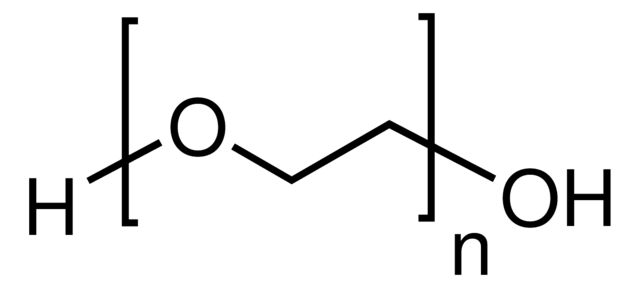
- General description: Poly(ethylene glycol) (PEG) is a biocompatible inert synthetic polymer with repeating units of ether oxygen (-CH2-CH2-O-). It can be synthesized via anionic polymerization of ethylene oxide. It is extensively used in biological and medical applications due to its non-immunogenicity and high water solubility.
- Application: PEG can be used to functionalize magnetite nanoparticles. The coating of the magnetic core with PEG provides good stabilization while maintaining the magnetic properties of the nanoparticles.It can be used to modify the surface of photocatalytic TiO2 nanopowder for its application in self-cleaning paints. PEG-coated TiO2 nanopowder can be prepared under mild conditions and show excellent colloidal stability.It can be used as a cross-linker to prepare poly(N-isopropylacrylamide) based thermosensitive injectable hydrogels. The addition of PEG improves the chemical and mechanical properties of hydrogel and prevents it from dissolving in the swelling medium. Owing to their biocompatibility and biodegradability, these hydrogels are widely used for biomedical applications.
- Features and Benefits: High structural flexibility Biocompatibility High hydration capacityDevoid of any steric hindrance
- Other Notes: Molecular weight: Mn 3,015-3,685
SAFETY INFORMATION
WGK
WGK 1
Flash Point(F)
Not applicable
Flash Point(C)
Not applicable
Personal Protective Equipment
dust mask type N95 (US), Eyeshields, Gloves