81240
Poly(ethylene glycol)
average Mn 4,000, hydroxyl
Manufacturer: Sigma Aldrich
CAS Number: 25322-68-3
Synonym(S): Polyethylene glycol, PEG
Select a Size
| Pack Size | SKU | Availability | Price |
|---|---|---|---|
| 1 KG | 81240-1-KG | In Stock | ₹ 6,116.10 |
| 5 KG | 81240-5-KG | In Stock | ₹ 18,947.70 |
81240 - 1 KG
In Stock
Quantity
1
Base Price: ₹ 6,116.10
GST (18%): ₹ 1,100.898
Total Price: ₹ 7,216.998
product name
Poly(ethylene glycol), average Mn 4,000, platelets
biological source
platelets
Quality Level
200
form
powder
mol wt
Mn 3,500-4,500average Mn 4,000
mp
58-61 °C
Ω-end
hydroxyl
α-end
hydroxyl
SMILES string
C(CO)O
InChI
1S/C2H6O2/c3-1-2-4/h3-4H,1-2H2
Other Options
| Image | Product Name | Manufacturer | Price Range | |
|---|---|---|---|---|
RIGAKU REAGENTS PEG 1000, 50%(w/v), 100 ml, CAS# 25322-68-3 | -- | ₹ 7,803.07 | ||
Electron Microscopy Sciences Carbowax Polyethylene Glycol, PEG 400 viscous liquid, 25322-68-3, 450ml | -- | ₹ 4,072.66 | ||
RIGAKU REAGENTS PEG 4000, 50%(w/v), 250 ml, CAS # 25322-68-3 | -- | ₹ 13,347.36 | ||
RIGAKU REAGENTS PEG 6000, 50%(w/v), 250 ml, CAS# 25322-68-3 | -- | ₹ 13,347.36 | ||
Medchemexpress LLC HY-Y0873 50mL , PEG300 CAS:25322-68-3 Purity:>98% | -- | ₹ 4,491.90 | ||
eMolecules PEG4000 | 25322-68-3 | MFCD00002882 | 100g | -- | ₹ 6,297.22 | ||
Poly(ethylene glycol) for GPC 108,000, MilliporeSigma™ Supelco™ | -- | ₹ 1,00,361.88 | ||
Poly(ethylene glycol) for GPC 12,000, MilliporeSigma™ Supelco™ | -- | ₹ 23,785.68 | ||
Poly(ethylene glycol) for GPC 20,000, MilliporeSigma™ Supelco™ | -- | ₹ 23,914.02 | ||
Poly(ethylene glycol) for GPC 200, MilliporeSigma™ Supelco™ | -- | ₹ 24,598.50 |
...
Related Products
Description
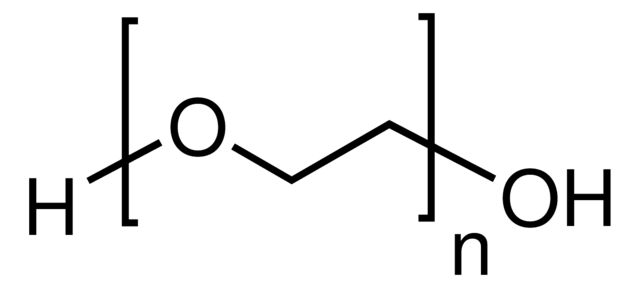
- General description: Polyethylene glycol (PEG) is a hydrophilic polymer. It can be easily synthesized by the anionic ring opening polymerization of ethylene oxide, into a range molecular weights and variety of end groups. When crosslinked into networks PEG can have high water content, forming “hydrogels PEG is a suitable material for biological applications because it does not trigger an immune response.
- Application: Polyethylene glycol (PEG) platelets were used:in PEG-directed gene delivery of protoplast transfection and incubation[1]to prepare extraction for measuring cytosolic phosphoenolpyruvate carboxykinase (PEPCK) from plant tissuesas DNA transformation agent in a study of transient gene expression of plant protoplasts, derived from rice leaf sheaths.[2]in preparing isothermal assembly buffer and TSS broth preparation for unique nucleotide sequence (UNS)-guided assembly of repetitive DNA parts[3]in transformation of DNA into log-phase cells of the budding yeast Saccharomyces cerevisiae.[4]as DNA transformation reagent[5]
- Other Notes: Polymer networks with grafted cell adhesion peptides for highly biospecific cell adhesive substrates[6]
SAFETY INFORMATION
WGK
WGK 1
Flash Point(F)
Not applicable
Flash Point(C)
Not applicable
Personal Protective Equipment
dust mask type N95 (US), Eyeshields, Gloves