P2139
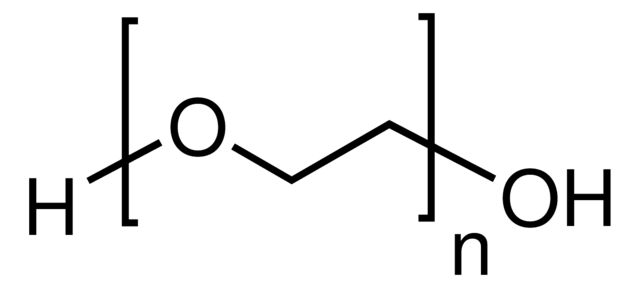
Poly(ethylene glycol)
average MN 8,000, hydroxyl
Manufacturer: Sigma Aldrich
CAS Number: 25322-68-3
Synonym(S): Polyethylene glycol, PEG
Select a Size
| Pack Size | SKU | Availability | Price |
|---|---|---|---|
| 500 G | P2139-500-G | In Stock | ₹ 8,857.80 |
| 1 KG | P2139-1-KG | In Stock | ₹ 15,928.50 |
| 2 KG | P2139-2-KG | In Stock | ₹ 19,724.70 |
P2139 - 500 G
In Stock
Quantity
1
Base Price: ₹ 8,857.80
GST (18%): ₹ 1,594.404
Total Price: ₹ 10,452.204
product name
Poly(ethylene glycol), average mol wt 8,000, powder
form
powder
Quality Level
200
mol wt
average mol wt 8,000
solubility
water: soluble (PEG is soluble in water approximately 630 mg/ml, 20 °C)
density
1.0845 g/mL at 70 °C1.0689 g/mL at 90 °C
Ω-end
hydroxyl
α-end
hydroxyl
SMILES string
C(CO)O
InChI
1S/C2H6O2/c3-1-2-4/h3-4H,1-2H2
Other Options
| Image | Product Name | Manufacturer | Price Range | |
|---|---|---|---|---|
RIGAKU REAGENTS PEG 1000, 50%(w/v), 100 ml, CAS# 25322-68-3 | -- | ₹ 7,803.07 | ||
Electron Microscopy Sciences Carbowax Polyethylene Glycol, PEG 400 viscous liquid, 25322-68-3, 450ml | -- | ₹ 4,072.66 | ||
RIGAKU REAGENTS PEG 4000, 50%(w/v), 250 ml, CAS # 25322-68-3 | -- | ₹ 13,347.36 | ||
RIGAKU REAGENTS PEG 6000, 50%(w/v), 250 ml, CAS# 25322-68-3 | -- | ₹ 13,347.36 | ||
Medchemexpress LLC HY-Y0873 50mL , PEG300 CAS:25322-68-3 Purity:>98% | -- | ₹ 4,491.90 | ||
eMolecules PEG4000 | 25322-68-3 | MFCD00002882 | 100g | -- | ₹ 6,297.22 | ||
Poly(ethylene glycol) for GPC 108,000, MilliporeSigma™ Supelco™ | -- | ₹ 1,00,361.88 | ||
Poly(ethylene glycol) for GPC 12,000, MilliporeSigma™ Supelco™ | -- | ₹ 23,785.68 | ||
Poly(ethylene glycol) for GPC 20,000, MilliporeSigma™ Supelco™ | -- | ₹ 23,914.02 | ||
Poly(ethylene glycol) for GPC 200, MilliporeSigma™ Supelco™ | -- | ₹ 24,598.50 |
...
Related Products
Description
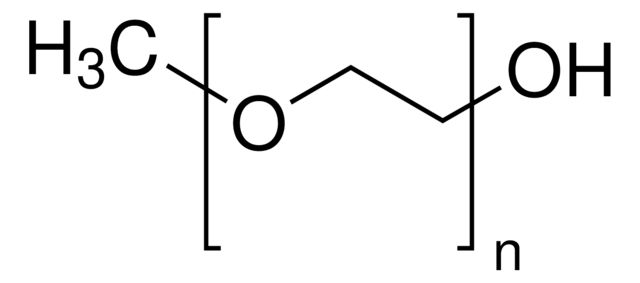
- General description: Polyethylene glycol (PEG) is a hydrophilic polymer. It can be easily synthesized by the anionic ring opening polymerization of ethylene oxide, into a range molecular weights and variety of end groups. When crosslinked into networks PEG can have high water content, forming “hydrogels”. PEG is a suitable material for biological applications because it does not trigger an immune response
- Application: Poly (ethylene glycol) can be used in the formulation of the drug to improve its dissolution rate and oral bioavailability.PEG can be used for the effective isolation of edible nanoparticles (ENPs) which have excellent anti-cancer and anti-inflammatory activities. PEG is a crowding agent and forms a net-like mesh in which nanovesicles are trapped and precipitated. For example, ginger-derived ENPs are isolated using a PEG-based method which is cost-effective compared to ultracentrifugation.PEG can be used as a precursor to synthesize degradable hydrogels for the controlled release of hydrophilic and high molecular weight pharmaceuticals.
- Features and Benefits: Highstructural flexibilityBiocompatibilityAmphiphilicityHighhydration capacityDevoidof any steric hindrance
SAFETY INFORMATION
WGK
WGK 1
Flash Point(F)
Not applicable
Flash Point(C)
Not applicable
Personal Protective Equipment
dust mask type N95 (US), Eyeshields, Gloves