Poly(ethylene glycol)
average MN 3,350, hydroxyl, BioXtra
Manufacturer: Sigma Aldrich
CAS Number: 25322-68-3
Synonym(S): Polyethylene glycol, PEG
Select a Size
| Pack Size | SKU | Availability | Price |
|---|---|---|---|
| 500 G | P4338-500-G | In Stock | ₹ 15,329.10 |
| 1 KG | P4338-1-KG | In Stock | ₹ 22,866.00 |
| 2 KG | P4338-2-KG | In Stock | ₹ 24,087.00 |
P4338 - 500 G
In Stock
Quantity
1
Base Price: ₹ 15,329.10
GST (18%): ₹ 2,759.238
Total Price: ₹ 18,088.338
product name
Poly(ethylene glycol), BioXtra, average mol wt 3,350, powder
product line
BioXtra
Quality Level
200
form
powder
mol wt
average mol wt 3,350
impurities
≤0.01% Phosphorus (P)≤0.1% Insoluble matter
solubility
water: soluble (PEG is soluble in water approximately 670 mg/ml, 20 °C)
density
1.0962 g/mL at 60 °C1.0764 g/mL at 80 °C
anion traces
chloride (Cl-): ≤0.05%sulfate (SO42-): ≤0.05%
cation traces
Al: ≤0.0005%Ca: ≤0.0005%Cu: ≤0.0005%Fe: ≤0.0005%K: ≤0.005%Mg: ≤0.0005%NH4+: ≤0.05%Na: ≤0.05%Pb: ≤0.001%Zn: ≤0.0005%
Other Options
| Image | Product Name | Manufacturer | Price Range | |
|---|---|---|---|---|
RIGAKU REAGENTS PEG 1000, 50%(w/v), 100 ml, CAS# 25322-68-3 | -- | ₹ 7,803.07 | ||
Electron Microscopy Sciences Carbowax Polyethylene Glycol, PEG 400 viscous liquid, 25322-68-3, 450ml | -- | ₹ 4,072.66 | ||
RIGAKU REAGENTS PEG 4000, 50%(w/v), 250 ml, CAS # 25322-68-3 | -- | ₹ 13,347.36 | ||
RIGAKU REAGENTS PEG 6000, 50%(w/v), 250 ml, CAS# 25322-68-3 | -- | ₹ 13,347.36 | ||
Medchemexpress LLC HY-Y0873 50mL , PEG300 CAS:25322-68-3 Purity:>98% | -- | ₹ 4,491.90 | ||
eMolecules PEG4000 | 25322-68-3 | MFCD00002882 | 100g | -- | ₹ 6,297.22 | ||
Poly(ethylene glycol) for GPC 108,000, MilliporeSigma™ Supelco™ | -- | ₹ 1,00,361.88 | ||
Poly(ethylene glycol) for GPC 12,000, MilliporeSigma™ Supelco™ | -- | ₹ 23,785.68 | ||
Poly(ethylene glycol) for GPC 20,000, MilliporeSigma™ Supelco™ | -- | ₹ 23,914.02 | ||
Poly(ethylene glycol) for GPC 200, MilliporeSigma™ Supelco™ | -- | ₹ 24,598.50 |
Related Products
Description
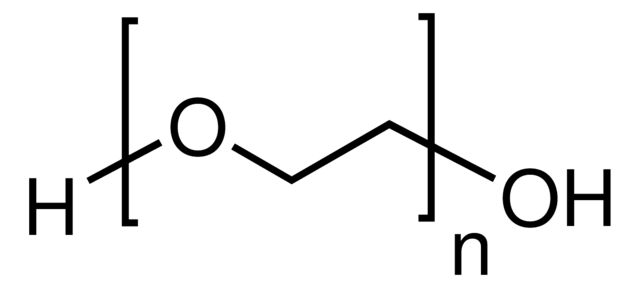
- General description: Polyethylene glycol (PEG) is a hydrophilic polymer. It can be easily synthesized by the anionic ring opening polymerization of ethylene oxide, into a range molecular weights and variety of end groups. When crosslinked into networks PEG can have high water content, forming “hydrogels”. PEG is a suitable material for biological applications because it does not trigger an immune response.
- Application: Poly (ethylene glycol) (PEG) can be used to functionalize magnetic nanoparticles in combination with nonionic surfactant Tween 80. PEG functionalization improves the biocompatibility of magnetite nanoparticles. It also reduces the surface charge and maintains the magnetic characteristics of nanoparticles.PEG can be used as an exterior coating for the pharmaceutical final dosage forms. This can avoid moisture from encountering active pharmaceutical ingredients. For example, Naproxen solid dispersions are coated with PEG by drop printing technique. The PEG layer protects the solid dispersions from moisture-accelerated crystallization and enhances their stability.Nanostructured hydroxyapatite (HAP) can be prepared by a sol-gel technique using PEG as an organic modifier. The addition of PEG has an influence on the morphology of HAP particles. At high temperatures, more flexible PEG molecules result in the formation of large-sized HAP platelets. At low synthesis temperatures, less flexible PEG colloids form nanostructured HAP.PEG powder can also be used as a laxative agent.
SAFETY INFORMATION
WGK
WGK 1
Flash Point(F)
Not applicable
Flash Point(C)
Not applicable
Personal Protective Equipment
dust mask type N95 (US), Eyeshields, Gloves