C0926
(2-Hydroxypropyl)-β-cyclodextrin
powder, BioReagent, suitable for cell culture
Manufacturer: Sigma Aldrich
CAS Number: 128446-35-5
Synonym(S): 2-hydroxypropylether, Beta-cyclodextrin
Select a Size
| Pack Size | SKU | Availability | Price |
|---|---|---|---|
| 5 G | C0926-5-G | In Stock | ₹ 40,961.80 |
| 10 G | C0926-10-G | In Stock | ₹ 67,667.08 |
C0926 - 5 G
In Stock
Quantity
1
Base Price: ₹ 40,961.80
GST (18%): ₹ 7,373.124
Total Price: ₹ 48,334.924
biological source
corn starch
Quality Level
300
product line
BioReagent
form
powder
mol wt
1396 Da
extent of labeling
4-10 (determined by NMR)
technique(s)
cell culture | mammalian: suitable
solubility
H2O: 100 mg/mL
shipped in
ambient
storage temp.
room temp
Other Options
Related Products
Description
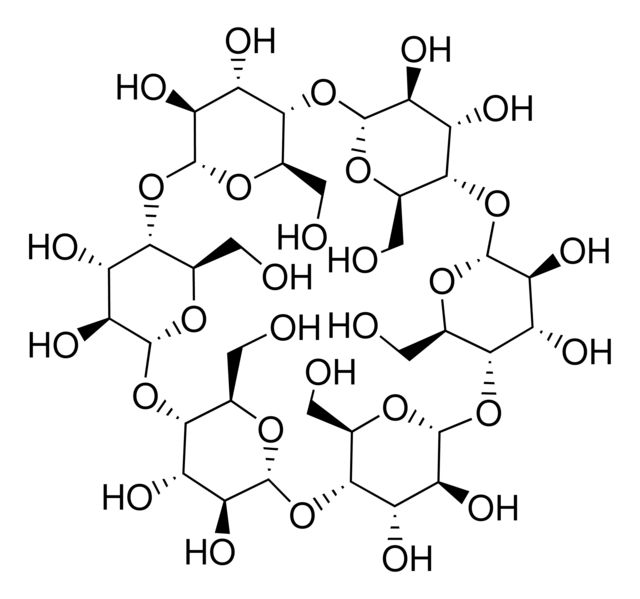
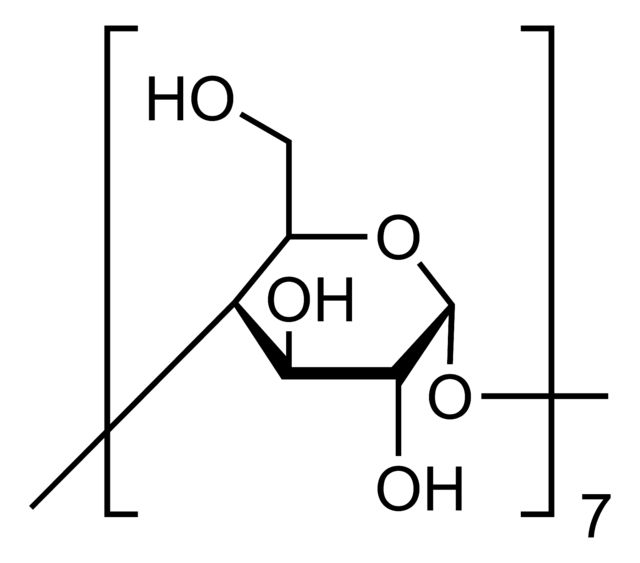
- General description: Cyclodextrins are cyclic oligosaccharides consisting of 6, 7, or 8 glucopyranose units, usually referred to as α-, β-, or γ-cyclodextrins, respectively. These compounds have rigid doughnut-shaped structures making them natural complexing agents. The unique structures of these compounds owe their stability to intramolecular hydrogen bonding between the C2- and C3-hydroxyl groups of neighboring glucopyranose units. The molecule takes on the shape of a torus with the C2- and C3-hydroxyls located around the larger opening and the more reactive C6-hydroxyl aligned around the smaller opening. The arrangement of C6-hydroxyls opposite the hydrogen bonded C2- and C3-hydroxyls forces the oxygen bonds into close proximity within the cavity, leading to an electron rich, hydrophobic interior. The size of this hydrophobic cavity is a function of the number of glucopyranose units forming the cyclodextrin.The solubility of natural cyclodextrins is very poor. In the late 1960′s, it was discovered that chemical substitutions at the 2, 3, and 6 hydroxyl sites would greatly increase solubility. Most chemically modified cyclodextrins are able to achieve a 50% (w/v) concentration in water.Cavity size is the major determinant as to which cyclodextrin is used in complexation. The cavity diameter of β-cyclodextrins or β-glucopyranose unit compounds is well-suited for use with molecules the size of hormones, vitamins and many compounds frequently used in tissue and cell culture applications. For this reason, β-cyclodextrin is most commonly used as a complexing agent.
- Application: The solubility of lipophilic drugs increases linearly with the concentration of hydroxypropyl-β-cyclodextrin (HBC) in aqueous solution because of the complex between HBC and the drug. This guest-host type complex is formed between the drug and the non-polar cavity in the HBC that results in enhanced solubility. Solutions may be lyophilized to produce freely soluble powders. Non-toxic in rabbits and mice.
- Preparation Note: Solutions may be stored for several months at 4°C. Solid should be stored tightly sealed at room temperature.
SAFETY INFORMATION
WGK
WGK 1
Flash Point(F)
>752.0 °F
Flash Point(C)
> 400 °C
Personal Protective Equipment
dust mask type N95 (US), Eyeshields, Gloves