H3784
HEPES sodium salt
Manufacturer: Sigma Aldrich
CAS Number: 75277-39-3
Synonym(S): 4-(2-Hydroxyethyl)piperazine-1-ethanesulfonic acid sodium salt, N-(2-Hydroxyethyl)piperazine-N′-(2-ethanesulfonic acid) sodium salt
Select a Size
| Pack Size | SKU | Availability | Price |
|---|---|---|---|
| 25 G | H3784-25-G | In Stock | ₹ 7,392.60 |
| 100 G | H3784-100-G | In Stock | ₹ 25,796.40 |
| 500 G | H3784-500-G | In Stock | ₹ 31,601.70 |
| 1 KG | H3784-1-KG | In Stock | ₹ 41,125.50 |
H3784 - 25 G
In Stock
Quantity
1
Base Price: ₹ 7,392.60
GST (18%): ₹ 1,330.668
Total Price: ₹ 8,723.268
grade
BioPerformance Certified
Quality Level
400
Assay
≥99.0%
form
powder
storage condition
dry at room temperature
technique(s)
activity assay: suitablecell culture | mammalian: suitable
impurities
endotoxin and total aerobic microbial count, tested
color
white
pH
10-12 (1 M in water)
useful pH range
6.8-8.2
Other Options
Related Products
Description
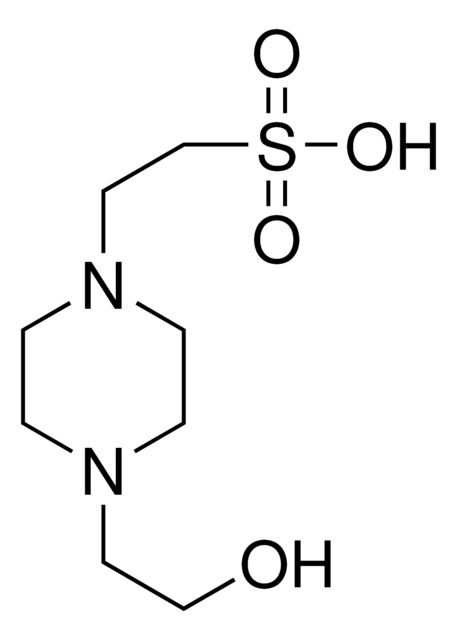
- General description: HEPES, or 4-(2-hydroxyethyl)piperazine-1-ethane-sulfonic acid, is a zwitterionic N-substituted aminosulfonic acid buffer with a remarkable pH buffering capacity between 6.8 and 8.2 (pKa of 7.48 at 25°C). Widely recognized for its versatility, HEPES is extensively employed in cell biology, biochemical, and biological research. Notably, its neutrality towards metal ions makes it a preferred choice for solutions with metal ions, acting as a "non-coordinating buffer."In cell culture, HEPES excels in maintaining stable physiological pH even amidst fluctuating carbon dioxide concentrations, outperforming bicarbonate buffers (NaHCO3). Moreover, HEPES showcases valuable properties in various biological and biochemical processes, such as isoelectric focusing for protein separation and minimal interference in DNA-restriction enzyme reactions, making it indispensable across diverse research applications, including immunoprecipitation, cell lysis, and live cell imaging. Its versatility, exceptional buffering capacity, and minimal interaction with molecules establish HEPES as a key tool in various research domains.
- Application: HEPES sodium salt has been used:to supplement the HSOF medium[1]as a buffer component of HCZB medium in egg and embryo culture[2]as a buffer component in cell culture[3]
- Features and Benefits: High-purity product for biochemical and biological researchTested to confirm low levels of heavy metal contamination, ensuring suitability for various applicationsHighly soluble in water with a useful pH range of 6.8 - 8.2 and pKa of 7.5 at 25 °CSuitable for Cell cultureTested for Endotoxins and Total Aerobic Microbial CountFree from DNase, NICKase, RNase, Endonuclease, Exonuclease and Protease
- Physical form: Lyophilized, spray dried, or crystallized material.
- Other Notes: For additional information on our range of Biochemicals, please complete this form.
SAFETY INFORMATION
WGK
WGK 3
Flash Point(F)
Not applicable
Flash Point(C)
Not applicable
Personal Protective Equipment
dust mask type N95 (US), Eyeshields, Gloves