H7006
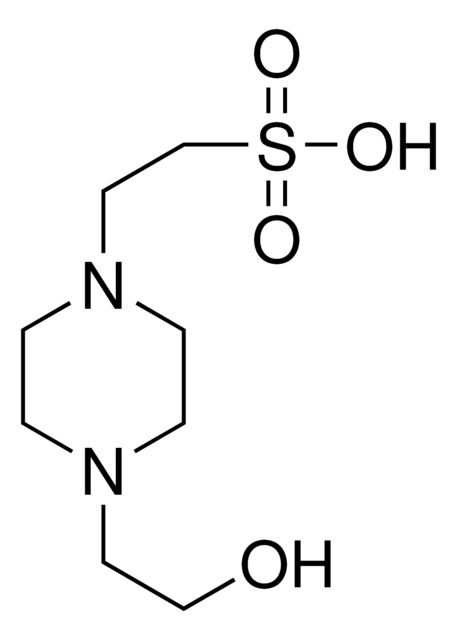
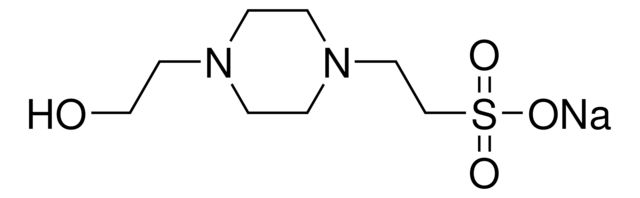
HEPES sodium salt
≥99.0% (titration)
Manufacturer: Sigma Aldrich
CAS Number: 75277-39-3
Synonym(S): Sodium 2-(4-(2-hydroxyethyl)piperazin-1-yl)ethanesulfonate, 4-(2-Hydroxyethyl)piperazine-1-ethanesulfonic acid sodium salt, N-(2-Hydroxyethyl)piperazine-N′-(2-ethanesulfonic acid) sodium salt
Select a Size
| Pack Size | SKU | Availability | Price |
|---|---|---|---|
| 25 G | H7006-25-G | In Stock | ₹ 7,314.90 |
| 100 G | H7006-100-G | In Stock | ₹ 17,871.00 |
| 500 G | H7006-500-G | In Stock | ₹ 63,558.60 |
| 1 KG | H7006-1-KG | In Stock | ₹ 89,321.70 |
| 2.5 KG | H7006-2.5-KG | In Stock | ₹ 2,03,318.70 |
H7006 - 25 G
In Stock
Quantity
1
Base Price: ₹ 7,314.90
GST (18%): ₹ 1,316.682
Total Price: ₹ 8,631.582
Quality Level
400
Assay
≥99.0% (titration)
form
powder
storage condition
dry at room temperature
technique(s)
HPLC: suitable
color
white
pH
10-12 (1 M in water)
useful pH range
6.8-8.2
pKa (25 °C)
7.5
solubility
water: 0.1 M, clear, colorless
Other Options
Related Products
Description
- General description: HEPES salt, or 4-(2-hydroxyethyl)piperazine-1-ethanesulfonic acid sodium salt, is a zwitterionic biological buffer that is widely used in biological and biochemical research. It has a buffering range of pH 6.8 to 8.2, making it ideal for a variety of research applications. HEPES is also a popular choice for buffering cell culture media, offering advantages such as lower cell toxicity in comparison to alternatives like Tris and phosphate.Widely utilized in cell biology and biochemical research, HEPES proves its versatility in protein purification and extraction protocols, owing to its stability across a broad pH range and minimal metal ion binding. Additionally, HEPES proves valuable in various biological and biochemical processes, including immunoprecipitation, cell lysis, and live cell imaging, making it a versatile tool in diverse research applications.
- Application: HEPES buffer finds application in: Most studies with metal ionsSubstitute for Tris and phosphate in studies with metal ionsGrinding buffer in plant studiesRunning buffer in gel electrophoresisBuffer in electroporation studiesBradford or bicinchoninic acid (BCA) assaysExtraction buffer to prevent damage of proteins in red blood cellsIt has been used:as a buffer component in the preparation of a low sucrose buffer[1]as a buffer component in a modified Hanks′ solution, a pseudo-physiological solutions[2]
- Features and Benefits: Tested to confirm low levels of heavy metal contamination, ensuring suitability for various applicationsHighly soluble in waterNegligible metal ion bindingLess toxic to cells than other buffers such as Tris and phosphateStable in a wide pH range
- Physical form: Lyophilized, spray dried, or crystallized material.
- Other Notes: For additional information on our range of Biochemicals, please complete this form.
SAFETY INFORMATION
WGK
WGK 3
Flash Point(F)
Not applicable
Flash Point(C)
Not applicable
Personal Protective Equipment
dust mask type N95 (US), Eyeshields, Gloves